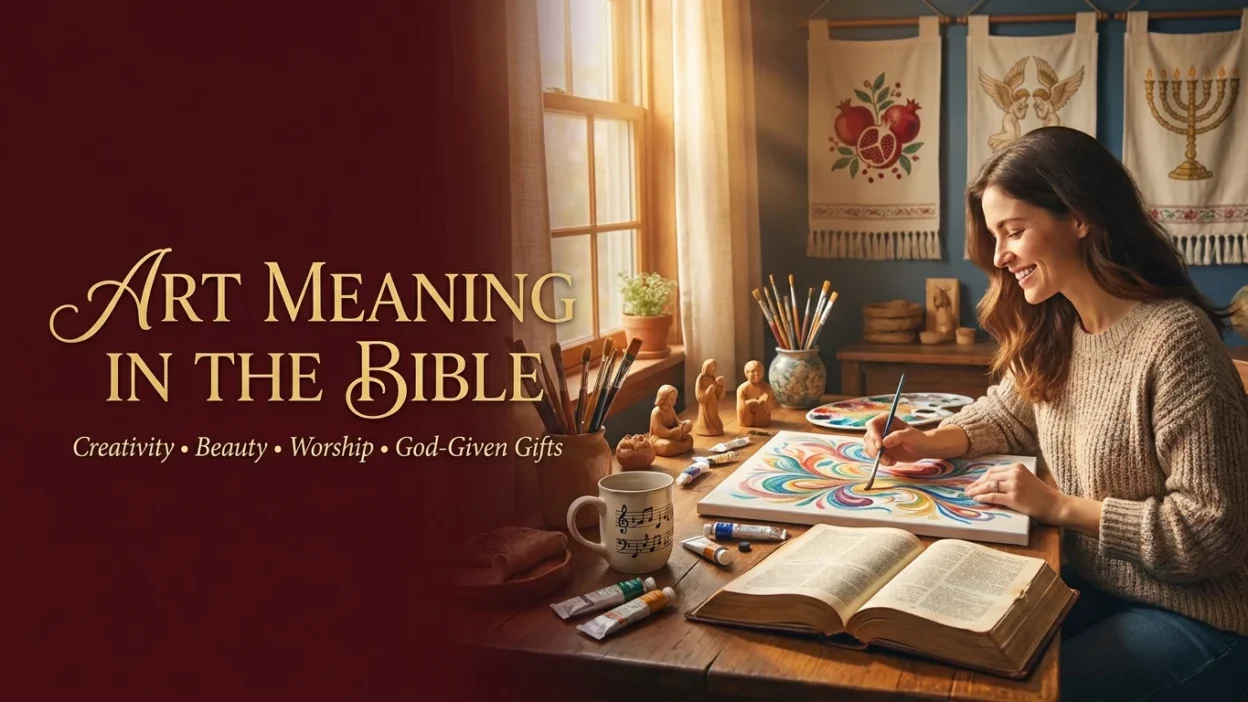
The art meaning in the Bible connects with some beautiful ideas about creativity, craftsmanship, beauty, worship, and God’s ability to create. Although the Bible does not treat “art” as a modern category in exactly the same way we understand it today, Scripture contains many examples of artistic work, including sculpture, embroidery, music, poetry, architecture, metalwork, painting-like decoration, and skilled craftsmanship.
From the creation account in Genesis to the detailed construction of the Tabernacle, the Bible shows that creativity can serve meaningful purposes. At the same time, Scripture warns against allowing artistic objects to become idols. Therefore, biblical art involves both creative expression and spiritual responsibility. When we explore art through Scripture, we can see how God gives people skills, imagination, and wisdom to create things that reflect beauty, communicate truth, and support worship.
Quick Answer
The art meaning in the Bible is closely connected with creativity, beauty, craftsmanship, worship, expression, and God’s creative nature.
Scripture presents artistic skill as something that can be used for God’s purposes, especially in worship and sacred craftsmanship. However, the Bible also warns against worshiping created objects instead of the Creator.
Does the Bible Talk About Art?
Yes, although the Bible does not use the modern concept of “art” exactly as we do today.
Scripture describes people creating beautiful objects, decorated furnishings, garments, buildings, musical instruments, poetry, sculptures, and other forms of craftsmanship.
One of the clearest examples appears in the construction of the Tabernacle.
God gave instructions for skilled workers to create beautiful and carefully designed objects for worship. This shows that creativity and craftsmanship can have spiritual value.
Therefore, the biblical view of art is not simply about decoration. Art can communicate beauty, meaning, identity, worship, history, and truth.
Art and God as the Creator
The foundation of biblical creativity begins with God Himself.
Genesis opens with the powerful declaration that God created the heavens and the earth.
Creation displays God’s power, wisdom, order, and beauty. Consequently, human creativity can be understood as one way people reflect the creative abilities God has given them.
This does not mean human artists create in exactly the same way God creates. Rather, people can use their imagination, intelligence, skills, and craftsmanship to make meaningful things.
That makes creativity a potentially valuable gift.
Art as a Gift From God
One of the strongest biblical examples appears in Exodus 31.
God specifically chose Bezalel and filled him with God’s Spirit, wisdom, understanding, knowledge, and skill for craftsmanship.
Bezalel worked on the Tabernacle and its furnishings.
This passage provides an important lesson:
Creative skill can be a gift from God.
Artistic ability does not have to be separated from faith. A person can use skills in design, music, writing, architecture, sculpture, painting, sewing, or craftsmanship in ways that honor God.
Art and Worship
The Bible contains many examples of artistic work connected with worship.
The Tabernacle included beautifully crafted objects, detailed garments, decorative elements, and precious materials.
The Temple also contained artistic features.
Furthermore, worship included music, poetry, singing, instruments, and skilled performance.
The book of Psalms itself demonstrates how artistic language can communicate profound spiritual truths.
Therefore, art can help people express praise, remember God’s works, communicate biblical truth, and engage emotionally with worship.
Biblical Art and Beauty
The Bible does not reject beauty.
In fact, Scripture frequently describes things that are beautiful, precious, majestic, skillfully made, or glorious.
The craftsmanship of the Tabernacle provides an excellent example.
God instructed the Israelites to create objects with care and beauty rather than treating worship as something careless or meaningless.
This suggests that beauty can have a place in spiritual life.
However, beauty should never become more important than God Himself.
Art and Creativity
Creativity involves bringing ideas into a visible, audible, or tangible form.
The Bible contains many creative expressions:
- Poetry
- Songs
- Music
- Architecture
- Embroidery
- Metalwork
- Woodworking
- Sculpture
- Storytelling
- Decorative craftsmanship
These examples demonstrate that biblical faith includes room for imagination and creative skill.
Consequently, Christians do not need to view every form of creativity as spiritually meaningless.
Instead, they can ask how their creative abilities can serve truth, beauty, love, and God.
Art and the Human Imagination
Art begins with ideas and imagination.
Although Scripture does not provide a complete theology of artistic imagination, the Bible repeatedly portrays people using wisdom, knowledge, skill, language, and craftsmanship.
Exodus 35:35, for example, describes people being given skill for various forms of craftsmanship.
This reminds us that creativity involves more than natural talent. Skill can be developed, and wisdom can guide how that skill is used.
Therefore, an artist can pursue both creative excellence and spiritual wisdom.
Is Art Mentioned in the Ten Commandments?
The Bible does not forbid all artistic images.
This is an important distinction.
The Second Commandment warns against making idols or carved images for worship.
However, Scripture itself contains artistic images and designs in places connected with worship.
For example, the Tabernacle included cherubim as part of its design.
Therefore, the biblical concern is not simply “art versus no art.”
Instead, Scripture addresses the danger of turning created things into objects of worship.
The problem arises when people give a created object the honor that belongs to God.
Art vs. Idolatry
This distinction is essential when discussing the art meaning in the Bible.
Art can represent an idea, tell a story, express emotion, or display beauty.
Idolatry, however, involves giving created things the place that belongs to God.
For example, a painting of a biblical scene can help someone reflect on Scripture. But treating the painting itself as possessing divine power would cross a very different line.
Therefore:
Art can point toward truth.
Idolatry replaces truth with the created object.
This difference helps explain why Scripture contains both artistic craftsmanship and strong warnings against idols.
Art and Spiritual Expression
People naturally express emotions through creative work.
The Bible contains numerous examples of joy, grief, worship, fear, gratitude, hope, and repentance expressed through songs and poetry.
The Psalms demonstrate this especially clearly.
David and other biblical writers expressed deeply personal experiences through poetic language.
Consequently, creative expression can help people process emotions and communicate spiritual experiences.
Art can become a way to express:
- Joy
- Gratitude
- Sorrow
- Faith
- Hope
- Repentance
- Worship
- Love
- Wonder
Art and Storytelling
Art can communicate stories without relying entirely on words.
Throughout Christian history, paintings, sculptures, architecture, music, and other creative forms have helped people remember biblical events and teachings.
However, Scripture itself remains the primary authority for understanding those events.
A painting can illustrate the story of Noah, Moses, David, Jesus, or the disciples, but the artwork represents an artist’s interpretation rather than becoming Scripture itself.
Therefore, art can support understanding without replacing God’s Word.
Art and God’s Glory
One meaningful biblical perspective is that creative work can direct attention toward God’s glory.
Psalm 19:1 declares that the heavens proclaim God’s glory.
Creation itself functions as a powerful testimony to God’s greatness.
Similarly, human creativity can sometimes cause people to pause and appreciate beauty, order, skill, and wonder.
When art encourages gratitude rather than pride, it can become a meaningful expression of the gifts God has given.
What Does Art Mean Spiritually?
From a Christian devotional perspective, art can represent several important themes:
| Artistic Theme | Spiritual Meaning |
|---|---|
| Creativity | Reflecting God’s creative nature |
| Beauty | Appreciating God’s goodness and creation |
| Craftsmanship | Using God-given skills faithfully |
| Worship | Expressing praise and devotion |
| Expression | Communicating emotions and faith |
| Storytelling | Helping communicate meaningful truths |
| Skill | Developing gifts with wisdom |
| Imagination | Exploring ideas and communicating meaning |
These themes are grounded in broader biblical principles rather than a single verse defining “art.”
What Does Creating Art Mean Spiritually?
Creating art can become a meaningful spiritual practice when it encourages gratitude, truth, beauty, reflection, or service.
An artist might paint nature because it inspires appreciation for God’s creation.
A musician might compose worship music.
A writer might create poetry that expresses faith.
A designer might use creativity to serve others.
A craftsman might develop beautiful work with excellence and integrity.
The important question is not simply:
“Is this art?”
Instead, consider:
“How am I using this gift, and what does it communicate?”
Is Art a Gift From God?
The Bible provides strong support for the idea that creative and craftsmanship abilities can come from God.
Exodus 31 specifically describes God giving Bezalel wisdom, understanding, knowledge, and skill for artistic craftsmanship.
Therefore, artistic talent can be viewed as a gift that carries responsibility.
Like every other gift, creativity can serve either good or harmful purposes.
The biblical principle is to use gifts with wisdom, humility, excellence, and love.
Art in Dreams
Some people search for the art meaning in the Bible because they see paintings, drawings, sculptures, or artistic scenes in dreams.
However, Scripture does not provide a universal dream dictionary where “art” always means one particular thing.
If art appears in a dream, the meaning depends on the context and details.
For example, creating beautiful art may personally represent creativity or purpose, while destroying art could represent loss, frustration, or change.
However, Christians should avoid automatically treating every artistic dream as a divine prophecy.
Art and Christianity Today
Christian artists continue to work across many creative fields, including:
- Painting
- Photography
- Music
- Film
- Graphic design
- Writing
- Architecture
- Sculpture
- Illustration
- Fashion
- Digital art
These creative forms can communicate Christian ideas, but they can also simply explore beauty, human experience, and creation.
Christian creativity does not require every artwork to contain an obvious religious symbol.
Instead, faith can influence the artist’s character, purpose, values, and approach to excellence.
Common Misconceptions About Art in the Bible
Myth 1: The Bible says all art is sinful.
This is incorrect. Scripture describes significant artistic craftsmanship, including work used for the Tabernacle and worship.
Myth 2: Christians cannot create images.
The Bible does not prohibit every image. The major concern involves idolatry and the worship of created objects.
Myth 3: Art is always spiritual.
Art can express spiritual ideas, but not every artwork has a supernatural meaning.
Myth 4: Beautiful art automatically pleases God.
Beauty alone does not determine whether something honors God. Purpose, content, character, and worship also matter.
Myth 5: Every piece of biblical-looking artwork represents exactly what Scripture says.
Artwork often includes an artist’s imagination and interpretation. Therefore, it should not automatically be treated as biblical fact.
Biblical Lessons About Art
The Bible gives several valuable lessons about creativity.
First, creativity can be a gift.
God gave people abilities for skilled craftsmanship.
Second, excellence matters.
The Tabernacle’s craftsmanship demonstrates careful attention to detail.
Third, beauty has value.
Scripture includes beautiful objects and artistic designs.
Fourth, creativity should not become idolatry.
Created things must never replace the Creator.
Finally, gifts should serve a good purpose.
Artistic abilities can encourage, communicate, worship, teach, and inspire.
Frequently Asked Questions
What is the art meaning in the Bible?
The art meaning in the Bible connects with creativity, beauty, craftsmanship, worship, expression, and God-given skill. Scripture shows that artistic abilities can serve meaningful purposes when used wisely.
Does the Bible support art?
Yes. Scripture describes extensive artistic craftsmanship, particularly in the construction of the Tabernacle and its furnishings. The Bible does not condemn art itself.
Is art a gift from God?
The Bible gives a strong example of God giving creative skill and craftsmanship to Bezalel in Exodus 31. This supports the idea that artistic ability can be a God-given gift.
Does the Bible forbid paintings and sculptures?
No. The Bible does not prohibit every image or sculpture. Instead, Scripture strongly warns against creating and worshiping idols.
What is the spiritual meaning of creating art?
Creating art can represent creativity, expression, beauty, worship, purpose, and stewardship of God-given gifts. Its spiritual value depends partly on how and why someone uses the gift.
Can art be used for worship?
Yes. The Bible includes music, poetry, craftsmanship, beautiful objects, and artistic designs within worship-related settings.
Is art connected to idolatry?
Art itself is not idolatry. Idolatry occurs when people worship or give divine honor to created things instead of God.
What does art symbolize spiritually?
From a Christian perspective, art can symbolize creativity, beauty, imagination, expression, craftsmanship, worship, and the responsible use of God-given abilities.
Final Thought
The art meaning in the Bible ultimately points us toward the beautiful reality that God is the Creator, and He gives people abilities to create, design, build, write, sing, and express meaningful ideas. Scripture shows that craftsmanship can play an important role in worship, beauty, communication, and service.
At the same time, biblical art requires wisdom and humility. Creativity should never become more important than the Creator. When people use their artistic gifts to communicate truth, appreciate beauty, serve others, and honor God, creativity can become a meaningful expression of the gifts He has given.
Art can point us toward beauty, but the Creator deserves the worship.

Adrian Vossley is a digital content specialist with extensive experience in SEO writing, content optimization, and online publishing. He develops high-quality articles that balance search performance with reader engagement. His approach emphasizes research, accuracy, and sustainable content strategies. Adrian continually studies evolving search engine guidelines to refine his editorial process.