
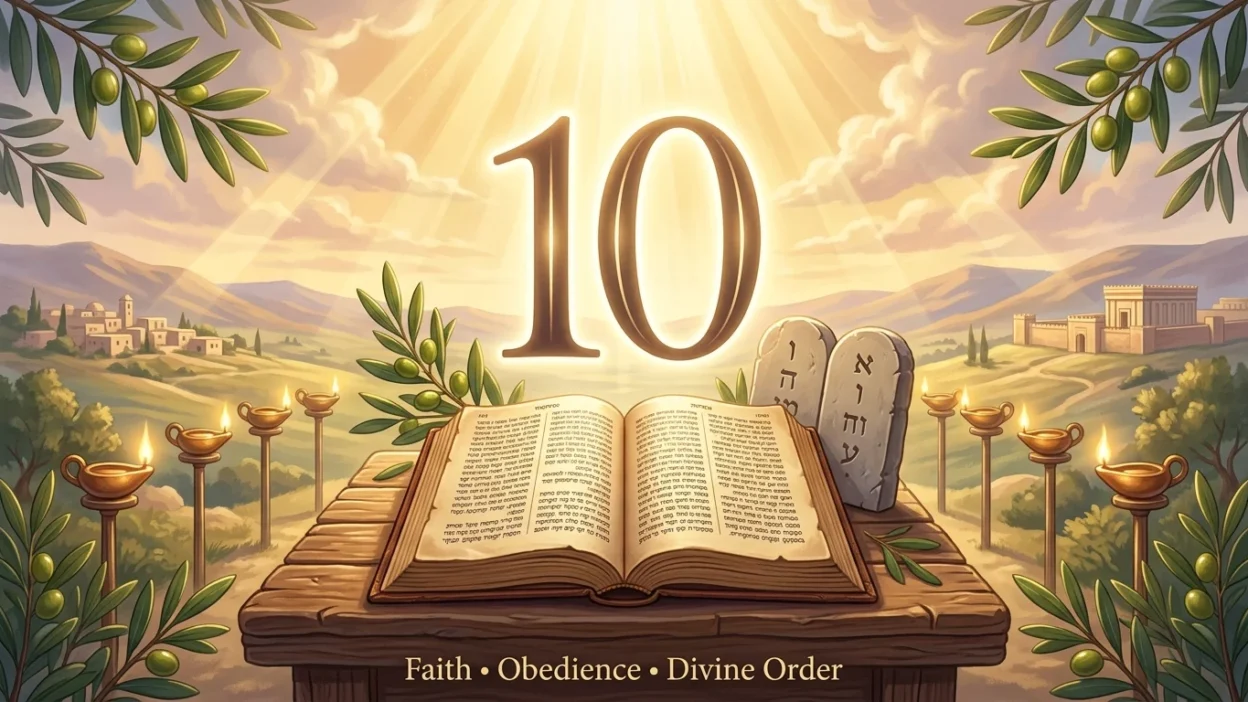
The biblical meaning of number 10 is one of the more recognizable numerical patterns in Scripture. The number appears throughout both the Old and New Testaments, often in connection with completeness, responsibility, testing, authority, and God’s established order. One of its most famous examples is the Ten Commandments, which God gave to Israel through Moses.
When exploring the biblical meaning of number 10, it is important to look at how Scripture actually uses the number rather than relying on modern numerology. Ten appears in important events involving God’s law, human responsibility, testing, and judgment. While the Bible does not give one sentence saying “10 always means this,” its repeated appearances create several meaningful biblical themes.
Quick Answer
The biblical meaning of number 10 is commonly associated with completeness, responsibility, testing, law, and divine order. The clearest example is the Ten Commandments, which represent God’s instructions for His covenant people. Other biblical examples also connect 10 with periods of testing and accountability.
What Does Number 10 Mean in the Bible?
Number 10 appears frequently in Scripture and often represents a complete set or established measure.
Important examples include:
- The Ten Commandments
- Ten plagues of Egypt
- Ten spies who gave a negative report
- Ten virgins in Jesus’ parable
- Ten minas in Jesus’ parable
- Ten lepers healed by Jesus
- Tithing, involving a tenth
Because of these examples, Christians often associate 10 with:
- Completeness
- Responsibility
- Law
- Testing
- Accountability
- Order
| Feature | Biblical Significance |
|---|---|
| Number | 10 |
| Major Theme | Completeness and Responsibility |
| Famous Example | Ten Commandments |
| Other Themes | Testing, Accountability, Order |
| Biblical Status | Frequently Used |
The Ten Commandments
The most famous biblical example of 10 is the Ten Commandments.
God gave these commandments to Israel through Moses at Mount Sinai. They established important principles for Israel’s relationship with God and with one another.
The commandments address areas such as:
- Worshiping God
- Rejecting idols
- Honoring God’s name
- Keeping the Sabbath
- Honoring parents
- Protecting human life
- Marriage
- Property
- Truthfulness
- Contentment
Because of this, the number 10 is strongly associated with God’s law, moral responsibility, and covenant order.
The Ten Plagues of Egypt
Another major example is the ten plagues God brought upon Egypt before Pharaoh released the Israelites.
The plagues demonstrated God’s authority over Egypt and its false gods while ultimately leading to Israel’s freedom.
The ten plagues included:
- Water turned to blood
- Frogs
- Gnats
- Flies
- Disease among livestock
- Boils
- Hail
- Locusts
- Darkness
- Death of the firstborn
This account gives the number 10 another connection with judgment, testing, deliverance, and God’s authority.
Ten Spies and a Test of Faith
In Numbers 13, Moses sent 12 spies to explore Canaan.
However, 10 of the spies brought back a negative report that frightened the Israelites. Only Joshua and Caleb trusted that God could give Israel the land.
The Israelites responded to the fearful report with unbelief.
This story connects 10 with a significant test of faith.
It also teaches that a majority opinion does not necessarily represent God’s truth.
Spiritual Meaning of Number 10
The spiritual meaning of 10 can therefore include:
- Completeness
- Responsibility
- Obedience
- Testing
- Accountability
- Divine order
- Faithfulness
- Moral responsibility
The number can remind believers that faith involves not only believing but also living according to God’s direction.
Number 10 and Completeness
Ten often represents a complete group or established amount.
For example, the Ten Commandments provide a complete foundational set of covenant instructions.
Similarly, Jesus’ parable of the ten virgins in Matthew 25 presents a complete group awaiting the bridegroom.
However, “completeness” should not be treated as an absolute definition for every occurrence of 10. Context remains important.
Number 10 and Testing
The Bible also connects 10 with testing.
One example appears in Daniel 1, where Daniel and his companions undergo a ten-day test involving their food and appearance.
Another example appears in Revelation 2:10, where believers in Smyrna are told they will experience tribulation for ten days.
These passages contribute to the idea that 10 can sometimes represent a defined period of testing or trial.
Number 10 and Tithing
Another important biblical connection is the tenth.
The Old Testament contains instructions involving giving a tenth of certain agricultural produce and possessions.
The concept of giving a tenth is commonly called tithing.
This gives 10 another connection with:
- Giving
- Stewardship
- Responsibility
- Gratitude
- Trust in God
The biblical principle emphasizes recognizing God as the provider and treating possessions responsibly.
Ten Lepers Healed by Jesus
In Luke 17, Jesus healed ten lepers.
Only one returned to thank Him.
This account highlights an important spiritual lesson about gratitude.
The ten received healing, but only one returned to glorify God and thank Jesus.
Therefore, this story can remind believers that receiving God’s blessings should lead to thankfulness and worship.
Number 10 in Jesus’ Parables
Jesus used the number 10 in several teachings.
Ten Virgins
Matthew 25 describes ten virgins waiting for the bridegroom.
The story emphasizes:
- Readiness
- Faithfulness
- Watchfulness
- Preparation
Ten Minas
In Luke 19, Jesus tells a parable involving ten minas.
The story teaches about responsibility and faithful stewardship.
These examples reinforce themes of accountability and preparation.
Comparison With Other Biblical Numbers
| Number | Common Biblical Theme |
|---|---|
| 3 | Significant biblical patterns, resurrection |
| 7 | Completion or fullness in various contexts |
| 10 | Responsibility, completeness, law, testing |
| 12 | God’s people, order, authority |
| 40 | Testing and preparation |
The number 10 has stronger biblical grounding than many numbers promoted in modern numerology.
Is Seeing Number 10 a Message From God?
The Bible does not teach that seeing 10 repeatedly means God is automatically sending you a personal message.
If you notice the number frequently, you can certainly use it as a reminder to reflect on biblical themes such as:
- Obedience
- Responsibility
- Faithfulness
- Gratitude
- Spiritual preparation
However, Christians should not use numbers to predict the future or replace Scripture.
Common Misconceptions About Number 10
Number 10 always means perfection.
Not necessarily. The Bible uses 10 in different contexts.
Seeing 10 guarantees a blessing.
Scripture does not make such a promise.
Number 10 is a lucky Christian number.
The Bible does not teach biblical numbers as lucky or unlucky.
Every appearance of 10 has a hidden message.
Not necessarily. Sometimes 10 simply records an actual quantity.
Why Is Number 10 Important to Christians?
Number 10 appears in many important biblical narratives.
From the Ten Commandments to the ten plagues, ten lepers, ten virgins, and ten minas, the number repeatedly appears in contexts involving responsibility, testing, obedience, preparation, and God’s authority.
Its significance comes from these biblical patterns rather than from mystical properties within the number itself.
How Should Christians Respond to Number 10?
If number 10 catches your attention, consider using it as a simple spiritual reminder.
Check your obedience. Are you following God’s teachings?
Examine your faith. Are you trusting God during difficult circumstances?
Practice gratitude. Remember the importance of thanking God for His blessings.
Be responsible. Use your time, abilities, and possessions wisely.
Stay prepared. Jesus’ teaching about the ten virgins emphasizes spiritual readiness.
Final Thought
The biblical meaning of number 10 is closely connected with completeness, responsibility, testing, obedience, accountability, and divine order. Its significance becomes especially clear through major biblical examples such as the Ten Commandments, ten plagues, ten spies, ten lepers, and ten virgins.
Rather than treating 10 as a mystical or lucky number, Christians can view its biblical patterns as reminders to live faithfully, accept responsibility, remain spiritually prepared, and trust God’s authority. When you encounter the number 10, let it point you back toward Scripture and the practical lessons it teaches about obedience, gratitude, faith, and faithful stewardship.
FAQs
What is the biblical meaning of number 10?
Number 10 is commonly associated with completeness, responsibility, law, testing, accountability, and divine order.
Why are there Ten Commandments?
The Ten Commandments provided foundational instructions for Israel’s covenant relationship with God and principles for living with others.
What do the ten plagues represent?
The ten plagues demonstrate God’s authority, judgment, deliverance, and power over Egypt.
What does 10 symbolize spiritually?
It can symbolize responsibility, obedience, testing, preparation, completeness, and faithfulness, depending on the biblical context.
Is number 10 lucky in Christianity?
No. Christianity does not teach that 10 is lucky or unlucky.
Does seeing number 10 repeatedly mean God is speaking?
The Bible does not teach that repeatedly seeing 10 automatically represents a personal message from God. Scripture should remain the foundation for spiritual guidance.

Corwin Haleford is an SEO content strategist and digital publishing expert with over a decade of experience creating search-focused content. He specializes in content optimization, topical authority, and user-first writing strategies that improve organic visibility. His work focuses on producing accurate, engaging, and data-informed articles across a wide range of industries. When he’s not researching search trends, Corwin enjoys exploring emerging technologies and digital media.