
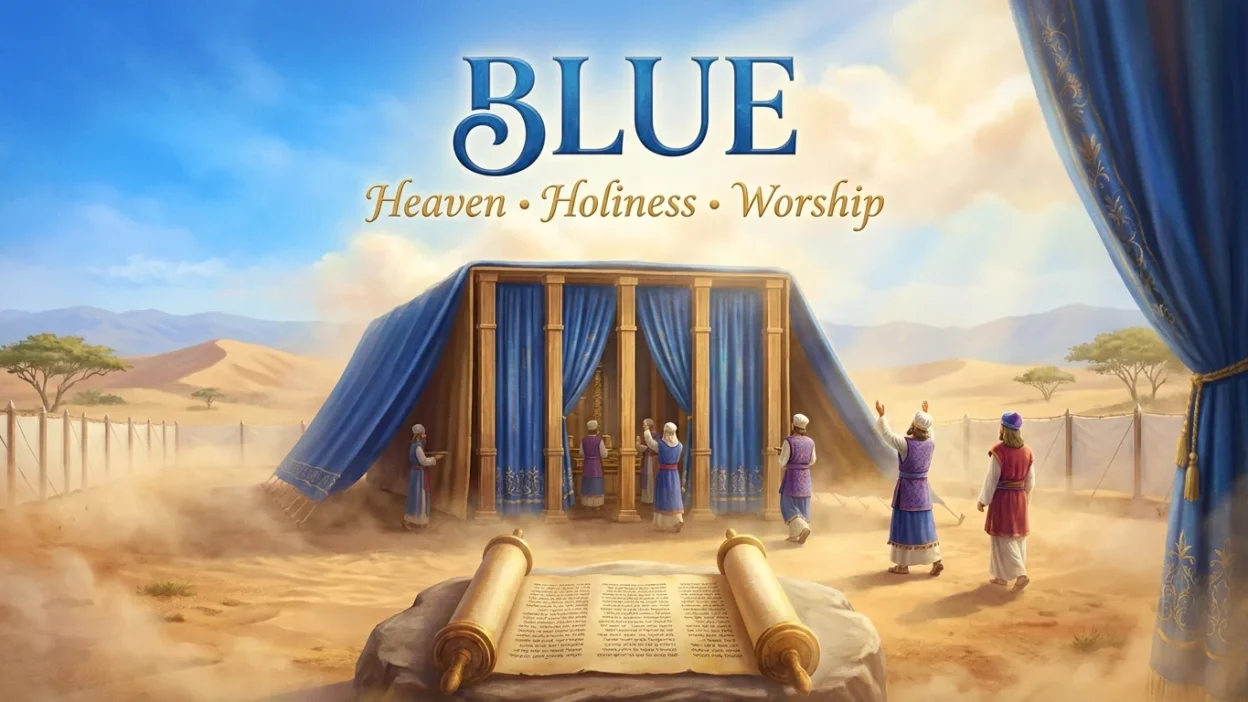
The blue meaning in the Bible is closely connected with heavenly things, sacred worship, God’s presence, and the beauty of creation. Blue appears several times in the Old Testament, especially in descriptions of the tabernacle, priestly garments, curtains, and sacred objects.
Unlike some modern color symbolism, however, the Bible does not give blue one simple definition that applies to every passage. Its meaning depends on the context, object, and biblical passage where it appears.
Still, blue carries an important place in biblical imagery. It often appears alongside purple, scarlet, fine linen, gold, and precious materials, particularly in God’s instructions for the tabernacle and priesthood. These associations can help us reflect on holiness, worship, God’s majesty, and the heavenly realm.
Quick Answer
The color blue in the Bible is often associated with heavenly things, sacred worship, God’s presence, holiness, and the glory of God. Blue appears prominently in the tabernacle and priestly garments in Exodus.
However, Scripture does not state that blue always has one fixed symbolic meaning. Its significance depends on the specific biblical context.
What Does Blue Mean in the Bible?
Blue appears most noticeably in the Old Testament descriptions of the tabernacle and priestly garments.
God instructed Moses to use blue materials in several elements of Israel’s worship.
For example, Exodus describes blue yarn being used alongside purple and scarlet yarn and fine linen.
These colors appeared in sacred objects and clothing connected with worship.
Because blue repeatedly appears in this holy setting, many biblical interpreters associate it with ideas such as:
- Heaven
- God’s presence
- Holiness
- Worship
- Divine authority
- Spiritual devotion
Still, we should avoid turning these associations into rigid rules that Scripture itself does not establish.
Blue and the Tabernacle
The tabernacle provides one of the strongest biblical contexts for understanding blue.
The tabernacle served as the central place of worship for ancient Israel during its wilderness journey.
God gave Moses detailed instructions about its construction.
Blue appears in:
- Curtains
- Coverings
- Veils
- Priesthood garments
- Sacred decorations
Exodus 26, for example, describes blue material among the colors used for the tabernacle curtains.
This connection gives blue a strong association with sacred worship and God’s dwelling among His people.
Blue and the High Priest
Blue also appears in the clothing of Israel’s high priest.
Exodus 28 describes the ephod, robe, breastpiece, and other priestly garments.
The robe of the ephod featured blue material, making blue part of the clothing associated with the priest’s sacred service.
The high priest served in a role that involved approaching God on behalf of Israel.
Therefore, blue’s presence in these garments can naturally remind readers of holiness, worship, God’s presence, and sacred service.
Blue and the Heavenly Realm
Many Christians associate blue with heaven because blue naturally reminds us of the sky.
The Bible contains imagery connecting the heavens with God’s glory.
For example, Psalm 19 declares that the heavens proclaim the glory of God.
However, we should make an important distinction.
The Bible does not simply say:
“Blue always means heaven.”
Instead, blue’s connection with heavenly things often comes from context and biblical imagery, particularly its use in sacred worship.
Blue and God’s Presence
The tabernacle represented God’s dwelling among His people.
Because blue appears throughout the tabernacle’s design, some Christians connect it with God’s presence.
This provides a meaningful spiritual reflection.
When you see the color blue, you can remember that God is not distant or indifferent. Scripture repeatedly presents Him as a God who dwells with, guides, and cares for His people.
The color itself does not create God’s presence, but it can serve as a visual reminder of biblical truths.
Blue and Holiness
Blue appears in objects associated with Israel’s worship and priesthood.
This setting naturally connects the color with holiness and sacred service.
The broader biblical message emphasizes that God’s people should approach Him with reverence.
Therefore, blue can serve as a reminder to live with reverence, obedience, and devotion to God.
Blue and Worship
Blue’s repeated appearance in the tabernacle makes it particularly relevant to the theme of worship.
The Israelites did not worship God casually.
God gave them detailed instructions concerning the tabernacle, priests, sacrifices, and sacred objects.
The presence of blue within this environment reminds modern readers that worship involves honoring God’s holiness and recognizing His greatness.
Blue in Exodus
Exodus contains some of the clearest references to blue.
God instructed Moses to use blue material in various parts of the tabernacle.
Exodus 25:4 mentions blue among the materials that the Israelites were to bring for the sanctuary.
Later chapters provide detailed instructions about how these materials would be used.
This demonstrates that blue was not simply an ordinary decorative color. It formed part of the visual design of Israel’s worship system.
Blue and the Priesthood
The priestly garments also contained blue.
Exodus 28:31 specifically describes the robe of the ephod as being made entirely of blue material.
This is particularly significant because the high priest occupied an important position within Israel’s worship.
The blue robe therefore existed within a setting of sacred responsibility and service before God.
Blue and God’s Majesty
Blue can also inspire reflection on God’s greatness and majesty.
The sky stretches above humanity and creates a natural image of vastness.
Scripture frequently uses the heavens to communicate God’s greatness.
Psalm 8, for example, directs attention toward the heavens and the works of God’s hands.
Although the passage does not assign a symbolic meaning to the color blue, the visual connection can encourage believers to reflect on the majesty of the Creator.
Does Blue Symbolize the Holy Spirit?
The Bible does not explicitly say that blue represents the Holy Spirit.
Some modern Christian teachings associate certain colors with particular spiritual concepts, but we should distinguish these traditions from direct biblical teaching.
The Holy Spirit receives many images in Scripture, including:
- Fire
- Wind
- Breath
- Water
- A dove in connection with Jesus’ baptism
Blue does not receive the same explicit identification.
Therefore, it is better to say that blue can remind someone of heavenly or sacred themes rather than claiming that blue directly symbolizes the Holy Spirit.
Does Blue Symbolize God’s Presence?
Blue appears in places associated with God’s worship and dwelling, particularly the tabernacle.
Because of this, many Christians associate blue with God’s presence.
However, Scripture does not provide a simple statement saying:
“Blue means God’s presence.”
The association comes from the broader context of blue’s use in sacred settings.
That distinction helps keep biblical interpretation accurate.
What Does Light Blue Mean in the Bible?
The Bible does not establish a separate symbolic meaning for light blue.
Modern Christian symbolism sometimes distinguishes shades of blue, but Scripture does not provide a detailed color chart assigning spiritual meanings to every shade.
Therefore, light blue can evoke thoughts of:
- Peace
- Sky
- Heaven
- Calmness
but these associations should remain personal or devotional, rather than being presented as explicit biblical doctrine.
What Does Dark Blue Mean in the Bible?
Similarly, Scripture does not give dark blue a separate official meaning.
The biblical references generally focus on blue materials used in sacred objects and garments rather than distinguishing different shades.
Therefore, claims that dark blue specifically means one particular spiritual concept should be treated cautiously.
Blue and the Ten Commandments
An interesting connection appears in Exodus 24.
When Moses and the elders of Israel experience a remarkable encounter with God, the text describes something beneath God’s feet resembling a pavement of sapphire, clear as the sky.
This passage creates a striking visual connection between blue-like heavenly imagery and God’s glorious presence.
However, sapphire and the color blue should not automatically receive identical meanings.
The passage primarily communicates God’s majesty and the extraordinary nature of the divine encounter.
Blue in the New Testament
Blue receives much less direct attention in the New Testament than in Exodus and other Old Testament descriptions.
The New Testament focuses more strongly on the fulfillment of God’s promises through Jesus Christ, rather than establishing a detailed system of color symbolism.
Therefore, when studying the biblical meaning of blue, the Old Testament tabernacle and priesthood passages provide the strongest evidence.
Spiritual Meaning of Blue
From a Christian devotional perspective, blue can remind believers of several important truths:
Heaven — the blue sky can direct our thoughts toward God’s heavenly realm.
Worship — blue appears in the design of the tabernacle.
Holiness — blue appears in garments and objects associated with sacred service.
God’s presence — its use in the tabernacle can remind us of God’s dwelling among His people.
Majesty — heavenly imagery can encourage reflection on God’s greatness.
Faithfulness — the sky and creation can remind us of the Creator’s ongoing care.
These applications can be meaningful as long as we recognize that they are reflections based on biblical imagery, not a universal biblical color code.
What Does Seeing Blue Mean Spiritually?
If you frequently notice the color blue, you do not need to assume that God is sending a secret message.
The Bible does not teach that repeatedly seeing a particular color automatically represents a prophecy.
However, you can use the experience as an opportunity to remember biblical truths.
Blue might remind you of God’s greatness, His presence, worship, or the beauty of His creation.
The important thing is to let Scripture—not superstition—guide your interpretation.
What Does Blue Mean in a Dream Biblically?
The Bible contains dreams and visions, but it does not give one universal interpretation for seeing blue in a dream.
A blue object might have different meanings depending on the dream’s context.
Therefore, Christians should avoid relying on modern dream dictionaries that claim every color has one fixed spiritual definition.
Instead, evaluate dreams carefully through Scripture, prayer, wisdom, and discernment.
Is Blue a Holy Color in the Bible?
Blue appears frequently in sacred contexts, particularly in the tabernacle and priestly garments.
For this reason, many Christians consider it a meaningful biblical color.
However, the Bible does not describe blue as inherently holy.
The holiness came from God and the sacred purpose of the objects, not from the color itself.
This distinction matters.
A color does not possess spiritual power.
Blue vs. Other Biblical Colors
The Bible uses several colors in important contexts.
| Color | Common Biblical Associations |
|---|---|
| Blue | Sacred worship, heavenly imagery, holiness |
| Purple | Royalty, wealth, dignity |
| Scarlet/Red | Blood, sacrifice, sin in certain contexts |
| White | Purity, righteousness, victory |
| Gold | Glory, value, holiness, wealth |
| Black | Mourning, darkness, famine in certain contexts |
These associations can help with biblical study, but context always matters.
A color does not automatically carry the same meaning every time it appears.
Common Misconceptions About Blue in the Bible
The Bible says blue always means heaven.
Not exactly. Blue appears in sacred contexts and can evoke heavenly imagery, but Scripture does not establish one universal definition.
Blue always represents the Holy Spirit.
No. Scripture does not explicitly identify blue as a symbol of the Holy Spirit.
Seeing blue is always a message from God.
The Bible does not teach that repeatedly seeing a color automatically represents divine communication.
Blue has supernatural power.
No. Biblical significance comes from the meaning God gives within Scripture, not from the color possessing spiritual power.
Every shade of blue has a different biblical meaning.
Scripture does not provide a detailed symbolic system for light blue, dark blue, navy blue, and other modern shades.
What Can Christians Learn From the Color Blue?
Blue can provide several beautiful devotional reminders.
Look toward God. The sky can remind us of the Creator’s greatness.
Value worship. Blue appears prominently in the tabernacle’s sacred design.
Respect God’s holiness. The priestly garments remind us that approaching God was treated with reverence.
Remember God’s presence. The tabernacle represented God’s dwelling among His people.
Admire creation. The beauty of the sky can inspire gratitude toward the Creator.
Stay grounded in Scripture. Personal symbolism should never replace biblical teaching.
Final Thought
The blue meaning in the Bible is most strongly connected with sacred worship, the tabernacle, priestly service, heavenly imagery, and God’s holiness and presence. Blue appears repeatedly in the Old Testament’s descriptions of the tabernacle and priestly garments, making it an important part of Israel’s visual language of worship. At the same time, Scripture does not give blue one rigid meaning that applies to every situation.
For Christians today, blue can serve as a beautiful reminder of God’s majesty, holiness, presence, and the heavenly realm. When you look at a blue sky or notice the color in everyday life, you can let it turn your attention toward the Creator. Just remember that the color itself has no supernatural power. Its deepest value comes from the biblical truths it can help us remember: God is holy, God is majestic, and God remains worthy of our worship.
FAQs
What does blue mean in the Bible?
Blue is strongly associated with the tabernacle, priestly garments, sacred worship, holiness, and heavenly imagery. Its exact meaning depends on the biblical context.
Is blue a biblical symbol of heaven?
Blue is often associated with heaven in Christian symbolism because of its connection with the sky and certain biblical imagery. However, the Bible does not explicitly state that blue always means heaven.
Does blue represent the Holy Spirit?
The Bible does not explicitly identify blue as a symbol of the Holy Spirit. Other images, such as fire, wind, water, and the dove, receive clearer biblical connections with the Spirit.
What does blue mean spiritually?
From a Christian devotional perspective, blue can remind believers of God’s presence, holiness, worship, heaven, and divine majesty.
Why was blue used in the tabernacle?
God instructed the Israelites to use blue materials in various parts of the tabernacle. Blue therefore formed part of the sacred visual design of Israel’s worship.
What does blue mean in a dream biblically?
The Bible does not give blue one universal meaning in dreams. Christians should avoid assuming that every dream or color automatically represents a divine message.
Does seeing blue mean God is sending a message?
Not necessarily. Scripture does not teach that seeing a particular color repeatedly automatically represents a supernatural message. However, blue can personally remind you of God’s creation and biblical truths.
Is blue a holy color?
Blue appears frequently in sacred biblical settings, but the Bible does not teach that the color itself possesses holiness or supernatural power.