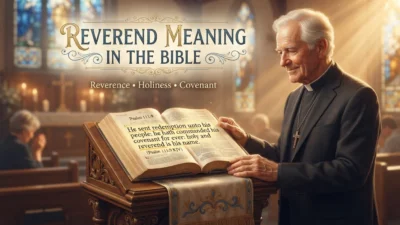
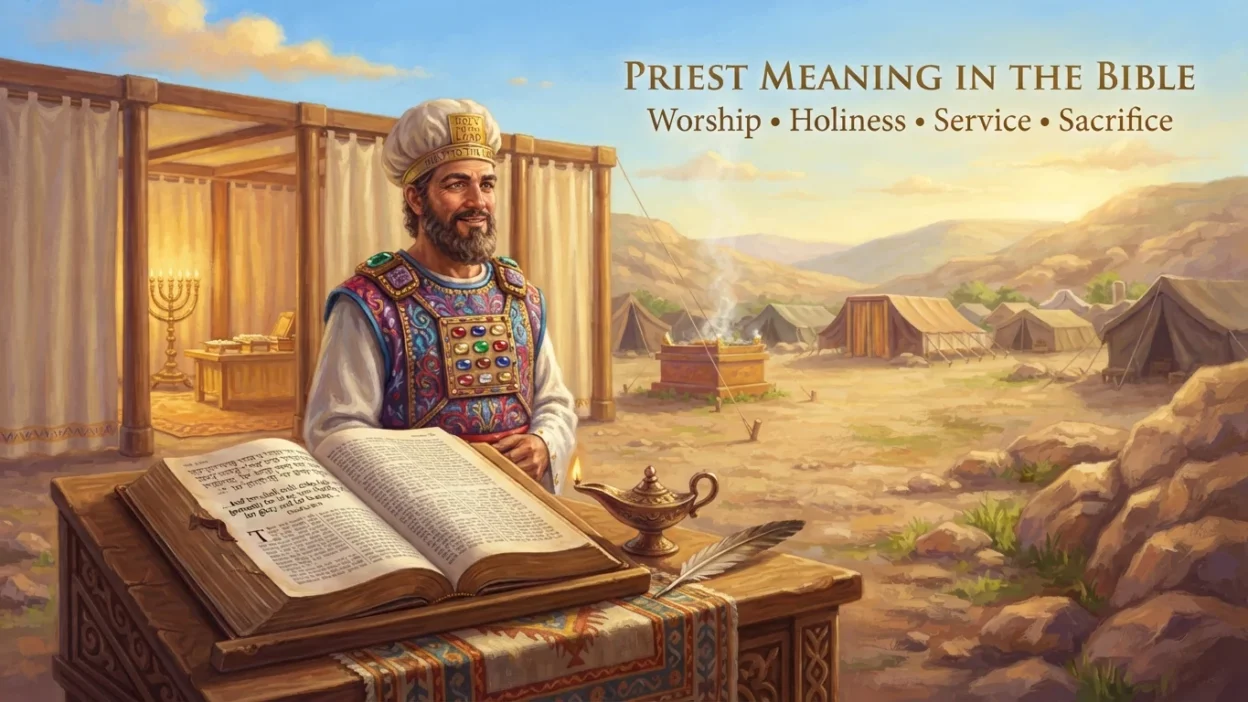
The priest meaning in the Bible is closely connected with worship, sacrifice, holiness, prayer, service, and representing the people before God. In the Old Testament, priests held an important position within Israel’s worship system. They served at the Tabernacle and later the Temple, offered sacrifices, cared for sacred responsibilities, taught God’s laws, and helped the people maintain proper worship.
However, the biblical meaning of a priest develops throughout Scripture. The Old Testament presents the Levitical priesthood, with Aaron and his descendants serving as priests. The New Testament then presents Jesus Christ as the ultimate High Priest, whose sacrifice provides the foundation for the Christian understanding of salvation. Furthermore, the New Testament describes believers collectively as a “royal priesthood,” emphasizing their calling to serve God and proclaim His works. Therefore, studying the priest meaning in the Bible reveals an important story about worship, holiness, sacrifice, mediation, and relationship with God.
Quick Answer
The priest meaning in the Bible refers to a person appointed to serve God in worship and perform sacred responsibilities on behalf of the people.
Old Testament priests offered sacrifices, served in the Tabernacle and Temple, taught God’s law, and maintained holy worship. In the New Testament, Jesus is presented as the ultimate High Priest, while believers are described as a royal priesthood called to serve and represent God’s purposes.
What Is a Priest in the Bible?
A priest in the Bible was a person set apart for sacred service to God.
The priesthood played a central role in Israel’s worship.
Priests were responsible for duties such as:
- Offering sacrifices
- Serving at the Tabernacle
- Later serving at the Temple
- Burning incense
- Caring for sacred objects
- Teaching God’s instructions
- Blessing the people
- Performing certain purification rituals
- Maintaining the holiness of worship
Therefore, the priest was not simply a religious leader.
A priest had a specific God-given responsibility within Israel’s covenant worship system.
What Does the Word Priest Mean?
The English word priest comes through older languages connected with the idea of a person who performs sacred or religious duties.
In the Old Testament, the Hebrew word commonly translated priest is kohen.
A kohen was a person who served in a priestly role, particularly within Israel’s worship system.
The New Testament commonly uses the Greek word hiereus for priest.
The terminology is important because it shows that the biblical priesthood was connected with sacred service and worship, rather than simply leadership in a modern organizational sense.
Who Was the First Priest in the Bible?
The Bible mentions Melchizedek as a priest of God Most High in Genesis 14:18.
Melchizedek appears before the establishment of Israel’s Levitical priesthood.
Later, Aaron becomes the central figure in the formal priesthood established for Israel.
Aaron served as Israel’s first High Priest under the Mosaic covenant, while his descendants served as priests.
Therefore, when discussing the priesthood, it is important to distinguish between Melchizedek’s priesthood, Aaronic priesthood, and the later Levitical system.
Aaron and the Priesthood
God appointed Aaron and his sons to serve as priests.
Exodus 28 describes the garments and responsibilities associated with Aaron’s priestly office.
Aaron’s position as High Priest was especially significant.
He represented Israel in important aspects of worship and entered the Most Holy Place on the appointed occasion described in Leviticus 16.
His role included:
- Offering sacrifices
- Making atonement according to God’s instructions
- Representing the people in worship
- Wearing specially appointed priestly garments
- Serving within the Tabernacle
The priesthood therefore involved both privilege and serious responsibility.
What Did Priests Do in the Bible?
Priests performed many different duties.
1. They Offered Sacrifices
One of the most recognizable priestly responsibilities involved sacrifices.
Leviticus describes different offerings that Israel brought to God.
Priests performed the sacrificial rituals according to God’s instructions.
These sacrifices were associated with worship, thanksgiving, purification, sin, and atonement, depending on the particular offering.
2. They Served in the Tabernacle
The Tabernacle was Israel’s central place of worship during the wilderness period.
Priests served there according to the responsibilities God established.
Their work included maintaining worship practices and handling sacred objects and rituals.
3. They Served in the Temple
After Solomon’s Temple was built in Jerusalem, priestly service continued there.
Priests performed sacrifices, maintained worship practices, and served according to the organization established for Temple ministry.
4. They Taught God’s Law
Priests also had teaching responsibilities.
Leviticus 10:11 instructs priests to teach the Israelites God’s statutes.
This demonstrates that priests were not only involved in ceremonies.
They also helped God’s people understand His instructions.
5. They Blessed the People
Numbers 6 contains the famous Aaronic blessing.
God instructed Aaron and his sons to bless the people.
The blessing begins with the words commonly known as:
“The LORD bless you and keep you.”
This demonstrates another important priestly responsibility: serving the spiritual and communal life of God’s people.
What Did the High Priest Do?
The High Priest held the highest priestly position within Israel’s priesthood.
Aaron served as the first High Priest.
The High Priest had responsibilities that other priests did not have.
One of the most important was entering the Most Holy Place on the Day of Atonement.
Leviticus 16 describes this special responsibility.
The High Priest represented Israel in this solemn act of worship and atonement.
The position required holiness, obedience, preparation, and reverence.
Priest vs. High Priest
The two roles were related but not identical.
| Priest | High Priest |
|---|---|
| Served within Israel’s priesthood | Held the highest priestly office |
| Performed various worship duties | Had unique responsibilities |
| Offered sacrifices | Had special Day of Atonement duties |
| Served at the Tabernacle and Temple | Entered the Most Holy Place on the appointed day |
| Descended from Aaron | Came from the Aaronic line |
This distinction helps clarify many Old Testament passages.
What Did Priests Wear?
The Bible gives detailed descriptions of priestly clothing.
Exodus 28 describes garments including:
- Ephod
- Breastpiece
- Robe
- Tunic
- Sash
- Turban
The High Priest’s breastpiece contained twelve stones, representing the twelve tribes of Israel.
These garments were not simply decorative.
They communicated the holiness, responsibility, and representative nature of the priestly office.
Why Were Priests Considered Holy?
Priests were set apart for sacred service.
The biblical concept of holiness involves being dedicated or set apart for God.
Because priests handled sacred responsibilities, God gave specific instructions concerning their behavior, clothing, sacrifices, cleanliness, and worship.
This does not mean that every priest was morally perfect.
The Bible records failures among priests as well.
Instead, their office carried a special responsibility before God.
Priest and Sacrifice
Sacrifice is one of the central themes connected with the biblical priesthood.
Under the Old Covenant, priests offered sacrifices according to God’s instructions.
These sacrifices pointed toward important themes such as:
- Atonement
- Forgiveness
- Worship
- Repentance
- Thanksgiving
- Purification
- Covenant relationship
However, the New Testament presents Jesus’ sacrifice as fundamentally different from the repeated sacrifices of the Old Covenant.
Jesus as the High Priest
One of the most important developments in the biblical meaning of priest appears in Hebrews.
The book of Hebrews repeatedly describes Jesus Christ as the great High Priest.
Hebrews 4:14 encourages believers to hold firmly to their confession because they have a great High Priest who has passed through the heavens.
Jesus’ priesthood is presented as superior to the old priestly system.
Why?
Because Jesus is not merely another priest offering another animal sacrifice.
He offers Himself.
His sacrifice is presented as once for all.
Jesus and the New Covenant
The New Testament connects Jesus’ priesthood with the New Covenant.
Hebrews explains that Jesus serves as a mediator of a better covenant.
Unlike the repeated sacrifices under the old system, Christ’s sacrifice is presented as sufficient and complete.
Hebrews 10 emphasizes that Christ offered one sacrifice for sins.
This is central to Christian theology.
Therefore, the priesthood moves from a repeated earthly sacrificial system toward the perfect priesthood and sacrifice of Christ.
Why Is Jesus Called a Priest?
Jesus is called a priest because He fulfills the priestly role in a unique and ultimate way.
He:
- Represents humanity before God
- Offers Himself as a sacrifice
- Provides access to God
- Intercedes for believers
- Serves as High Priest
- Mediates the New Covenant
Hebrews 7 especially develops this theme.
Jesus’ priesthood is associated with Melchizedek, rather than being based on Aaron’s hereditary priesthood.
Jesus as Mediator
A priest traditionally stood between God and the people in a representative worship role.
The New Testament presents Jesus as the unique mediator between God and humanity.
1 Timothy 2:5 emphasizes one God and one mediator between God and humanity, Jesus Christ.
This does not mean Jesus is merely another priest.
Rather, Christian theology presents Him as the ultimate mediator and High Priest.
Are Christians Priests?
The New Testament uses remarkable language when describing believers.
1 Peter 2:9 calls Christians a “royal priesthood.”
This does not mean every believer becomes an Old Testament priest who performs animal sacrifices.
Instead, the New Testament describes believers as people who belong to God and are called to serve, worship, proclaim His works, and live holy lives.
This is sometimes called the priesthood of believers.
What Does “Royal Priesthood” Mean?
The phrase royal priesthood comes from 1 Peter 2:9.
It emphasizes the identity and calling of God’s people.
Believers are described as:
- A chosen people
- A royal priesthood
- A holy nation
- God’s special possession
The purpose is connected with proclaiming the praises of God.
Therefore, being part of a royal priesthood means that Christians are called to represent God’s character through their lives and proclaim His works.
Spiritual Meaning of Priest
From a broader spiritual perspective, the priest can represent:
| Theme | Spiritual Meaning |
|---|---|
| Worship | Serving and honoring God |
| Holiness | Being set apart for God |
| Sacrifice | Giving oneself to God |
| Intercession | Praying on behalf of others |
| Service | Helping God’s people |
| Teaching | Communicating God’s truth |
| Blessing | Serving and encouraging others |
| Mediation | Pointing people toward reconciliation with God |
These themes become especially significant when understood through Christ’s priesthood.
Priest and Prayer
Although priests had many responsibilities, the broader biblical concept of priesthood can also remind Christians of intercession.
Intercession means praying on behalf of another person.
Christians can pray for:
- Family
- Friends
- Church communities
- Leaders
- People experiencing suffering
- Those who need spiritual guidance
The New Testament encourages believers to pray for others.
However, Christians should distinguish ordinary Christian intercession from Christ’s unique role as High Priest and mediator.
Priest Meaning in the Bible and Holiness
The priesthood strongly emphasizes holiness.
Priests served in sacred spaces and followed specific instructions because worship involved approaching a holy God.
For Christians today, holiness is not primarily about wearing priestly clothing or performing Old Testament rituals.
Instead, the New Testament calls believers to live lives that reflect faith, obedience, love, purity, humility, and devotion to God.
Common Misconceptions About Priests in the Bible
Myth 1: Priests were simply pastors.
Not exactly. Biblical priests served within Israel’s sacrificial and worship system. Their responsibilities were different from the role of a modern pastor.
Myth 2: Every priest was a High Priest.
No. The High Priest held a unique position above the other priests.
Myth 3: Jesus was an ordinary Levitical priest.
No. Hebrews presents Jesus as High Priest according to the order of Melchizedek, not as an Aaronic priest.
Myth 4: Christians must perform Old Testament sacrifices.
Christian theology understands Jesus’ sacrifice as the fulfillment of the sacrificial system, so Christians do not continue the Old Testament animal-sacrifice system.
Myth 5: Only clergy can serve God.
The New Testament describes believers collectively as a royal priesthood, emphasizing that all Christians have a calling to worship, serve, and proclaim God’s works.
What Can We Learn From the Biblical Priesthood?
The priesthood offers several important lessons.
First, worship requires reverence.
The priests approached sacred responsibilities with specific instructions from God.
Second, service is a responsibility.
Priestly ministry involved serving God’s people.
Third, holiness matters.
The priesthood demonstrates the importance of being set apart for God.
Fourth, prayer and intercession matter.
God’s people are encouraged to pray for others.
Finally, Christ fulfills the priestly role.
The New Testament directs attention toward Jesus as the ultimate High Priest whose sacrifice establishes the foundation of the New Covenant.
Frequently Asked Questions
What is the priest meaning in the Bible?
A priest in the Bible was a person appointed for sacred service, worship, sacrifice, teaching, and other responsibilities connected with God’s covenant people. The priesthood was especially important in the Old Testament.
Who was the first priest in the Bible?
The Bible identifies Melchizedek as a priest of God Most High in Genesis 14:18. Later, Aaron became the first High Priest within the formal Israelite priesthood established under the Mosaic covenant.
What did priests do in the Bible?
Priests offered sacrifices, served at the Tabernacle and Temple, taught God’s law, maintained sacred worship, performed certain rituals, and blessed the people.
What is the difference between a priest and a High Priest?
The High Priest held the highest position within Israel’s priesthood and had unique responsibilities, including entering the Most Holy Place on the Day of Atonement.
Why is Jesus called the High Priest?
The book of Hebrews presents Jesus as the ultimate High Priest who offers Himself as a once-for-all sacrifice and serves as mediator of the New Covenant.
Are Christians considered priests in the Bible?
Yes. 1 Peter 2:9 describes believers as a royal priesthood. This emphasizes their calling to belong to God, worship Him, serve others, and proclaim His works.
What does priest symbolize spiritually?
The priest can represent worship, holiness, service, sacrifice, intercession, teaching, and devotion to God. These themes find their fullest Christian expression in Jesus’ role as High Priest.
What is the priesthood of believers?
The priesthood of believers refers to the New Testament teaching that Christians collectively have a direct calling to worship, serve God, proclaim His works, and live as His representatives, rather than leaving spiritual service exclusively to a special class of people.
Final Thought
The priest meaning in the Bible reveals a powerful story about worship, holiness, sacrifice, service, and access to God. In the Old Testament, priests served an essential role in Israel’s worship and sacrificial system. They taught God’s law, offered sacrifices, cared for sacred responsibilities, and served the people.
However, the story reaches its fullest meaning in Jesus Christ, the ultimate High Priest. His sacrifice and ministry stand at the center of the New Testament’s understanding of salvation and the New Covenant. At the same time, believers are called a royal priesthood, reminding Christians that every follower of Christ has a meaningful calling to worship, serve, pray, proclaim God’s truth, and live a holy life.
The biblical priesthood ultimately points beyond a religious position toward a life of devoted service to God.

Rowan Ashmere is an experienced content strategist specializing in SEO, digital publishing, and editorial planning. He creates informative content designed to improve online visibility while maintaining a strong focus on quality and user experience. His work combines thorough research, strategic optimization, and clear communication. Rowan enjoys analyzing search trends and developing content that delivers long-term value.