
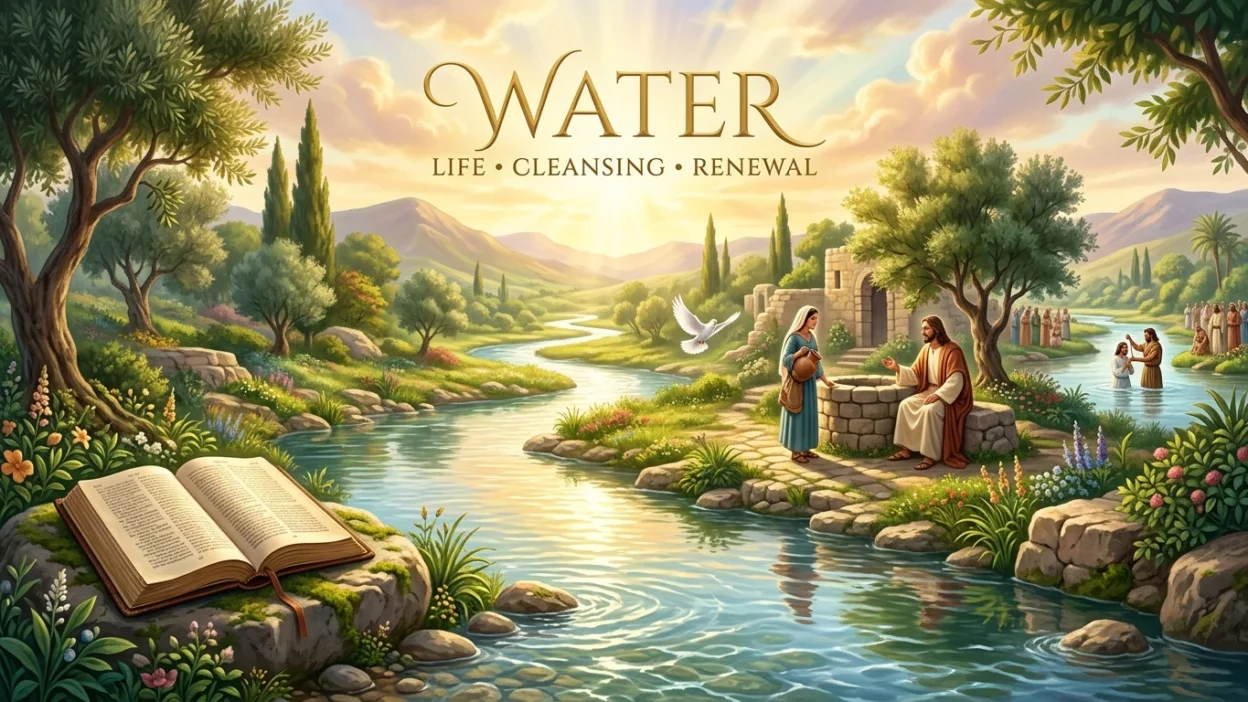
The meaning of water in the Bible is deeply connected with life, cleansing, renewal, baptism, salvation, the Holy Spirit, and God’s provision. Water appears from the very beginning of Scripture in the creation account and continues throughout the Bible in stories involving floods, wells, baptism, miracles, and Jesus’ teachings.
Water can represent both life and judgment. God uses water to sustain His creation, while the flood in Genesis demonstrates its connection with judgment. In the New Testament, Jesus also uses water as a powerful picture of spiritual life and eternal satisfaction.
Because water appears in many different contexts, its meaning depends on the passage. Nevertheless, its recurring imagery offers a beautiful picture of God’s power to cleanse, restore, sustain, and give new life.
Quick Answer
The biblical meaning of water is commonly associated with life, cleansing, renewal, baptism, spiritual transformation, salvation, and the Holy Spirit. Water can also represent judgment, as seen in the flood of Noah. Jesus’ teaching about living water points to the spiritual life and satisfaction that come from Him.
What Does Water Represent in the Bible?
Water carries several important biblical meanings:
- Life
- Cleansing
- Purification
- Renewal
- Baptism
- Salvation
- The Holy Spirit
- Spiritual nourishment
- God’s provision
- Judgment
The meaning changes according to the biblical context.
| Biblical Theme | Symbolic Meaning |
|---|---|
| Water | Life and provision |
| Washing | Cleansing and purification |
| Baptism | Repentance and new life |
| Living water | Spiritual life and satisfaction |
| Flood | Judgment and salvation |
| Rain | God’s provision and blessing |
| River | Life, restoration, and God’s presence |
| Sea | Power, danger, and God’s sovereignty |
Water and Creation
Water appears at the beginning of the Bible.
Genesis 1 describes the waters as part of the world God created and ordered.
This immediately establishes water as an important part of God’s created world.
Without water, earthly life cannot continue.
Therefore, water naturally becomes a biblical picture of life, nourishment, and God’s sustaining power.
Water as a Symbol of Life
Water is essential for human and animal life.
The Bible frequently uses this basic reality to communicate spiritual truths.
Psalm 23 describes God as leading His people beside still waters, creating an image of peace, provision, and restoration.
Psalm 42:1 also compares a person’s longing for God with a deer longing for water.
The message is powerful:
Just as the body needs water, the soul needs God.
Water and Cleansing
Water also represents cleansing.
Throughout the Old Testament, washing with water appears in various purification practices.
These rituals helped distinguish what was ceremonially clean from what was unclean.
This provides a powerful spiritual picture.
Water can represent the desire to be cleansed from impurity and restored to fellowship with God.
Water and Baptism
One of the most important New Testament uses of water is baptism.
John the Baptist baptized people in water as they responded to his call to repentance.
Jesus Himself was baptized by John.
Christian baptism later became an important expression of faith, repentance, identification with Christ, and new life.
Romans 6 connects baptism with the believer’s identification with Jesus’ death and resurrection.
Therefore, water in baptism can represent spiritual transformation and newness of life.
Water and Repentance
John’s baptism strongly connects water with repentance.
People came confessing their sins and responding to John’s message.
Water therefore became part of a powerful picture:
Turning away from sin → cleansing → renewed commitment to God.
The physical water itself does not magically remove sin.
Rather, baptism serves as a visible expression of spiritual repentance and faith.
Jesus and Living Water
One of the most beautiful biblical images of water appears in John 4.
Jesus speaks with the Samaritan woman at a well and introduces the idea of living water.
He explains that the water He gives can become a spring within a person leading to eternal life.
Here, water represents something far deeper than physical hydration.
Jesus points toward spiritual satisfaction and eternal life.
What Is “Living Water”?
In biblical language, “living water” can refer to fresh or flowing water.
Jesus uses the expression spiritually in John 4.
The woman initially understands Him to be talking about physical water.
Jesus, however, is describing the spiritual life He provides.
This creates a beautiful contrast:
Physical water satisfies temporary thirst.
Jesus provides spiritual life that reaches into eternity.
Water and the Holy Spirit
Water also appears alongside imagery connected with the Holy Spirit.
In John 7:37–39, Jesus invites thirsty people to come to Him and drink. John explains that Jesus was speaking about the Spirit.
This passage creates a close relationship between water imagery and the Spirit’s work.
The imagery communicates refreshment, spiritual life, abundance, and God’s presence.
Water and Salvation
Water can symbolize salvation and spiritual renewal.
Isaiah 55:1 uses the image of water when inviting those who are thirsty to come and receive what God provides.
Revelation 22 also contains the beautiful image of the river of the water of life flowing from God’s throne.
This river represents the abundance of life found in God’s presence.
Water and God’s Provision
Rain and flowing water frequently demonstrate God’s ability to provide for His creation.
In a largely agricultural society, rainfall was essential.
Without sufficient rain, crops failed.
Therefore, rain could represent God’s provision and blessing.
Deuteronomy 11:14 speaks of rain in its proper seasons as part of God’s provision for the land.
Water and Spiritual Refreshment
Water can also symbolize refreshment.
Imagine walking through a dry land and discovering a clear stream.
That physical experience provides a powerful picture of what God’s presence can mean during difficult seasons.
Isaiah 43:2 promises God’s presence when His people pass through waters.
The passage does not promise that believers will never face difficult circumstances.
Instead, it emphasizes:
God is with you while you pass through them.
Water and God’s Presence
Throughout Scripture, water sometimes appears alongside God’s powerful presence.
The Israelites crossed the Red Sea during the Exodus.
Joshua and Israel crossed the Jordan River when entering the Promised Land.
Jesus demonstrated His authority by walking on water.
These stories repeatedly show that God has authority over circumstances that humans cannot control.
Water and God’s Power
Water can be both life-giving and dangerous.
The Bible uses this dual nature to demonstrate God’s sovereignty.
God provides water for His creation, yet He also controls seas, floods, rivers, and storms.
Jesus’ calming of the storm demonstrates His authority over the sea.
This gives water another important biblical theme:
God is greater than the forces that seem impossible to control.
Water and the Flood of Noah
The story of Noah provides one of the clearest examples of water representing judgment and salvation at the same time.
The flood brought judgment upon widespread human wickedness.
Yet God preserved Noah and his family through the flood.
Thus, water can represent:
Judgment for rebellion
and simultaneously
deliverance for those whom God saves.
This reminds us that biblical symbols can carry more than one meaning.
Water and the Red Sea
The crossing of the Red Sea provides another powerful water story.
The Israelites faced an apparently impossible barrier.
God opened a path through the sea and delivered His people from Pharaoh’s army.
Water therefore becomes part of a story about:
- Deliverance
- God’s power
- Faith
- Protection
- Freedom
- A new beginning
The Israelites left slavery behind and began a new chapter.
Water and the Jordan River
The Jordan River also holds major biblical significance.
Israel crossed the Jordan when entering the Promised Land.
Later, John the Baptist baptized people in the Jordan.
Jesus was baptized there as well.
The Jordan therefore becomes associated with transition, obedience, repentance, and new beginnings.
Water and Jesus Walking on the Sea
When Jesus walked on the water in Matthew 14, His disciples were frightened.
Jesus demonstrated His authority over the sea and told them not to fear.
Peter then stepped out of the boat toward Jesus.
This story teaches about:
Faith in the middle of fear.
The water becomes the setting for a powerful lesson about trusting Jesus when circumstances appear impossible.
Water and Spiritual Transformation
Water can provide a beautiful image of transformation.
A person can move from:
Dryness → refreshment
Impurity → cleansing
Death → life
Old life → new life
These themes appear repeatedly throughout Scripture.
Water itself does not create spiritual transformation, but biblical water imagery points toward God’s ability to renew and restore.
Water and God’s Word
Psalm 1 compares a righteous person to a tree planted by streams of water.
The tree receives continual nourishment and produces fruit.
This gives water an additional spiritual lesson.
Just as a tree needs water to flourish, believers need continual nourishment from God’s truth and presence.
A spiritually dry life needs renewal.
Water and the River of Life
Revelation 22 provides one of the Bible’s most beautiful pictures of water.
John sees the river of the water of life flowing from the throne of God and of the Lamb.
The river is connected with:
- Life
- God’s presence
- Healing
- Restoration
- Eternal blessing
This image points toward the future fullness of God’s kingdom.
Spiritual Meaning of Water
The spiritual meaning of water in the Bible can be summarized as:
Life — God sustains His creation.
Cleansing — water represents purification.
Renewal — water provides a picture of spiritual refreshment.
Baptism — water represents repentance and identification with Christ.
Living water — Jesus provides spiritual life and eternal satisfaction.
Holy Spirit — water imagery can describe the Spirit’s life-giving work.
Provision — rain and rivers demonstrate God’s care.
Judgment — the flood shows water can also represent God’s judgment.
Is Water a Symbol of the Holy Spirit?
In some passages, yes, water imagery connects closely with the Holy Spirit.
John 7:37–39 is an important example.
However, water does not always represent the Holy Spirit.
In other passages, water clearly refers to literal water, cleansing, judgment, or physical provision.
Therefore, context remains essential.
Is Water a Symbol of Baptism?
Water is an essential physical element of Christian baptism.
Baptism provides a visible picture of repentance, faith, death to the old life, and new life in Christ.
However, the meaning of baptism should come from the biblical teaching surrounding it rather than from the physical water alone.
Does Water Always Mean Something Positive?
No.
This is an important point.
Water can symbolize:
- Life
- Cleansing
- Blessing
- Renewal
But it can also appear in contexts involving:
- Judgment
- Danger
- Fear
- Chaos
The flood is a clear example.
Therefore, you should always examine the specific biblical passage before assigning symbolic meaning.
What Does It Mean to Dream About Water Biblically?
The Bible contains dreams and visions involving water, but it does not provide a universal rule saying that dreaming about water always means one specific thing.
A dream about clear water, a stormy sea, or a river may have different meanings depending on the biblical context and the dream itself.
Christians should be careful about treating every dream as a divine message.
Prayer, Scripture, wisdom, and discernment remain important.
Is Seeing Water a Sign From God?
The Bible does not teach that seeing water automatically means God is sending a personal sign.
However, water can remind you of biblical truths such as God’s provision, cleansing, renewal, and spiritual life.
Rather than trying to decode every occurrence of water, use it as an opportunity to remember God’s Word.
Common Misconceptions About Water in the Bible
Water always represents the Holy Spirit.
No. The meaning depends on context.
Water itself has supernatural power.
The Bible does not teach that ordinary water automatically provides spiritual protection or blessings.
Every dream about water has a biblical message.
Scripture does not establish such a rule.
Baptism is merely a symbolic bath.
Christian baptism carries profound theological meaning connected with repentance, faith, Christ’s death, and resurrection.
Water always symbolizes blessing.
No. The flood demonstrates that water can also appear in a context of judgment.
Why Is Water So Important in the Bible?
Water was essential to life in the ancient world.
People needed it for:
- Drinking
- Farming
- Washing
- Travel
- Animals
- Crops
- Daily survival
Because water was so important, biblical writers could use it to communicate profound spiritual truths.
Water became an especially powerful picture of life, cleansing, renewal, provision, and God’s sustaining presence.
How Should Christians Apply the Biblical Meaning of Water?
The symbolism of water offers several practical lessons.
Seek spiritual refreshment. Bring your thirst for meaning and purpose to God.
Remain spiritually nourished. Stay connected to Scripture and prayer.
Embrace renewal. Allow God to transform areas of your life that need change.
Trust God during storms. Remember Jesus’ authority even when circumstances feel overwhelming.
Live faithfully. Let your life produce spiritual fruit like a tree planted beside water.
Remember God’s provision. Just as water sustains physical life, God sustains His people.
Final Thought
The meaning of water in the Bible is wonderfully rich, representing life, cleansing, renewal, baptism, spiritual nourishment, salvation, God’s provision, and the work of the Holy Spirit. From the waters of creation and Noah’s flood to the Jordan River, Jesus’ teaching about living water, and the river of life in Revelation, Scripture repeatedly uses water to communicate God’s power to sustain, cleanse, restore, and give life.
Yet water can also represent judgment and danger, reminding us that its meaning always depends on context. Ultimately, biblical water points us toward a deeper truth: our souls need God just as our bodies need water. Jesus’ promise of living water beautifully captures this hope—those who come to Him can receive spiritual life, renewal, and lasting satisfaction.
FAQs
What does water symbolize in the Bible?
Water commonly symbolizes life, cleansing, renewal, baptism, spiritual nourishment, salvation, and God’s provision.
What does living water mean in the Bible?
Jesus’ living water refers to the spiritual life and eternal satisfaction He provides, especially in John 4.
Does water represent the Holy Spirit?
In some passages, particularly John 7:37–39, water imagery connects with the work of the Holy Spirit. However, water does not always represent the Spirit.
What does water mean in baptism?
Water in baptism represents repentance, spiritual transformation, identification with Christ, and new life.
Can water symbolize judgment?
Yes. The flood of Noah is a major example of water representing God’s judgment while also providing the setting for Noah’s deliverance.
What does dreaming about water mean biblically?
The Bible does not give one universal interpretation for dreams about water. The meaning depends on the context, and Christians should avoid treating every dream as a divine message.
What does seeing water mean spiritually?
Seeing water is not automatically a sign from God. However, it can remind believers of God’s provision, cleansing, renewal, spiritual life, and faithfulness.

Rowan Ashmere is an experienced content strategist specializing in SEO, digital publishing, and editorial planning. He creates informative content designed to improve online visibility while maintaining a strong focus on quality and user experience. His work combines thorough research, strategic optimization, and clear communication. Rowan enjoys analyzing search trends and developing content that delivers long-term value.