The biblical meaning of number 13 has fascinated Bible readers for centuries. Some people associate 13 with rebellion, disorder, or bad luck, while others believe it carries a deeper spiritual message. However, the Bible does not explicitly say that the number 13 is always negative or unlucky. Instead, its meaning comes from examining the passages where the number or its patterns appear and considering the surrounding biblical context.
The biblical meaning of number 13 is often connected with rebellion and human resistance to God, especially because Genesis 14:4 describes certain kings serving Chedorlaomer for twelve years and rebelling in the thirteenth year. Yet this does not establish a universal biblical rule that 13 represents evil. In biblical numerology, context matters. The number can therefore encourage reflection on obedience, spiritual maturity, repentance, and trusting God’s authority.
Quick Answer
The number 13 is sometimes associated with rebellion or disobedience in biblical symbolism, particularly because of Genesis 14:4. However, the Bible does not call 13 an unlucky number or assign it one universal meaning. Its spiritual lesson depends on the biblical context.
What Is the Biblical Meaning of Number 13?
There is no single verse that declares, “13 means rebellion.”
Instead, biblical number symbolism develops through recurring patterns and themes.
The number 13 has often become associated with:
- Rebellion
- Disobedience
- Resistance
- Transformation
- Repentance
- Spiritual testing
- Moving away from old patterns
However, Christians should avoid treating biblical numbers like a fixed codebook. Scripture gives numbers significance in particular contexts, but not every appearance of a number necessarily carries a hidden spiritual message.
Number 13 in Genesis 14
One of the most commonly discussed references appears in Genesis 14:4.
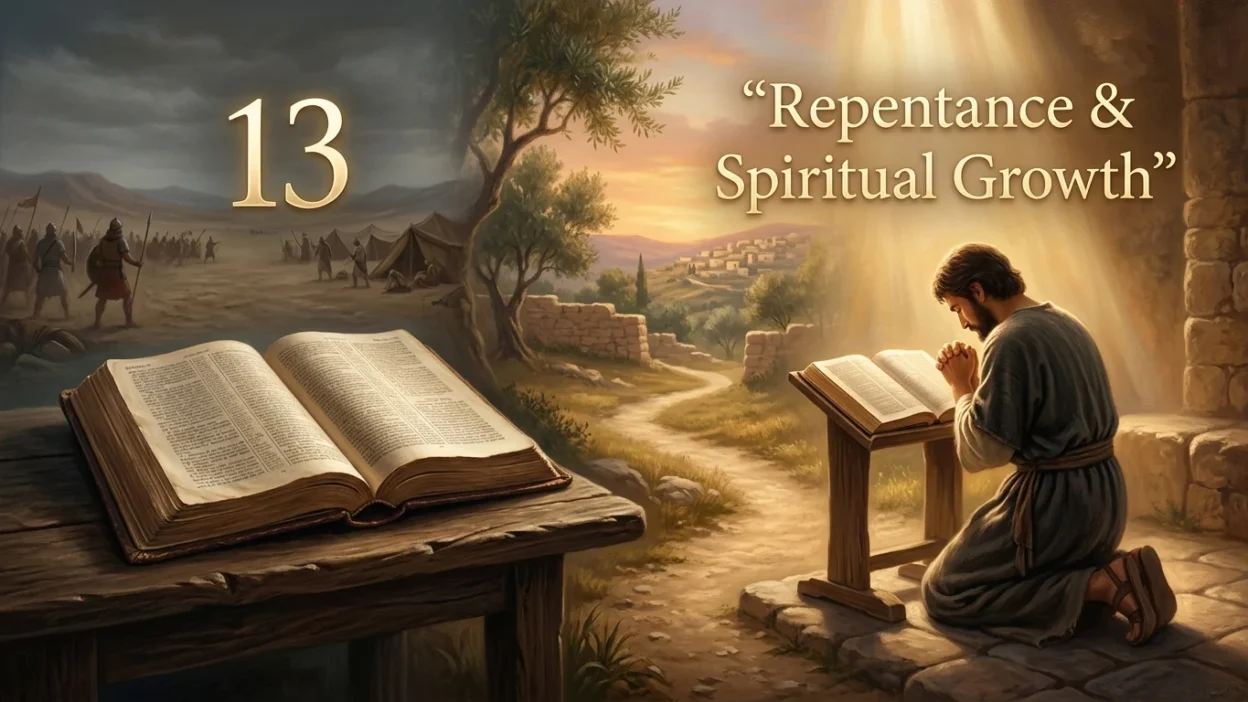
The passage describes several kings who had served Chedorlaomer for twelve years. In the thirteenth year, they rebelled.
This connection explains why some biblical interpretations associate 13 with rebellion.
However, the passage does not say that the number itself caused or symbolized the rebellion. The number simply identifies the year in which the rebellion occurred.
Therefore, it is safer to say that 13 has been associated with rebellion in biblical symbolism, rather than claiming that the Bible officially defines 13 as “the number of rebellion.”
Number 13 and Rebellion
The association with rebellion becomes popular because of several biblical patterns.
Genesis 14 provides the clearest example:
12 years of service → 13th year → rebellion
This sequence has led some interpreters to view 13 as representing a departure from an established order.
Spiritually, this can provide a lesson about:
- Recognizing disobedience
- Examining one’s choices
- Returning to God
- Resisting temptation
- Developing spiritual maturity
Does Number 13 Mean Bad Luck?
No.
The Bible does not teach that the number 13 brings bad luck.
The idea that 13 is unlucky largely comes from cultural traditions and superstitions rather than biblical teaching.
Christians should therefore avoid believing that seeing the number 13 automatically predicts:
- Misfortune
- Death
- Financial problems
- Bad events
- God’s judgment
A number does not control a person’s future.
Spiritual Meaning of Number 13
From a symbolic Christian perspective, 13 can serve as a reminder to examine obedience and spiritual direction.
Rather than fearing the number, someone might use it as a reminder to ask:
- Am I following God’s direction?
- Have I allowed rebellion into my life?
- Do I need to repent of something?
- Am I trusting God during change?
- Am I growing spiritually?
In this sense, the number can become a reminder of self-examination and spiritual renewal.
Is Number 13 Always Negative in the Bible?
No.
This is an important distinction.
Although some passages and traditional interpretations connect 13 with rebellion, the Bible does not consistently portray every occurrence of 13 as negative.
Biblical numbers should always be interpreted according to their context.
For example, a number appearing in a genealogy, measurement, age, or historical timeline does not automatically carry a symbolic message.
Number 13 and the Hebrew Bible
Some Jewish and Christian traditions have explored numerical symbolism in Hebrew Scripture. However, these interpretations can vary significantly.
The Bible itself does not provide a formal system stating:
“Every number has exactly one spiritual meaning.”
Therefore, readers should distinguish between:
What Scripture explicitly teaches and what later biblical numerology interprets symbolically.
This distinction prevents superstition and exaggerated claims.
Number 13 and Biblical Numerology
Biblical numerology studies recurring numerical patterns in Scripture.
Some numbers have especially recognizable biblical associations:
| Number | Common Biblical Association |
|---|---|
| 1 | Unity |
| 3 | Divine completeness |
| 4 | Creation / Earth |
| 7 | Completion / Perfection |
| 10 | Order / Completeness |
| 12 | Government / God’s people |
| 13 | Often associated with rebellion |
The final category deserves caution. While 13 is traditionally associated with rebellion, the Bible does not establish it as an official symbolic definition.
Number 13 vs. Number 12
Understanding 13 becomes easier when comparing it with 12.
The number 12 appears frequently in biblical contexts involving God’s people and organized leadership:
- Twelve tribes of Israel
- Twelve apostles
- Twelve foundations in the New Jerusalem
Because Genesis 14 describes rebellion occurring after twelve years, some interpreters view 13 symbolically as a movement away from established order.
This produces a simple symbolic contrast:
| Number | Common Symbolic Idea |
|---|---|
| 12 | Order, government, God’s people |
| 13 | Rebellion or departure from order |
Again, this is interpretive symbolism, not a biblical command.
Why Do People Search for the Biblical Meaning of 13?
People often search for the biblical meaning of number 13 because they repeatedly notice the number in everyday life.
For example, someone might frequently see:
- 13 on a clock
- House number 13
- Date of the 13th
- Number 13 in dreams
- 13 in important personal events
This can make people wonder whether God is sending them a message.
However, Scripture does not instruct Christians to interpret every repeated number as a divine sign.
It is wiser to focus on prayer, Scripture, wisdom, and the circumstances surrounding a situation.
What Does Seeing Number 13 Mean Spiritually?
If you repeatedly notice 13, there is no biblical basis for saying that it definitely means something specific.
Instead, you can use the experience as an opportunity for reflection.
You might ask:
Am I resisting something God is teaching me?
Do I need to make a better decision?
Is there an area where I need repentance or spiritual growth?
Am I trusting God rather than fear?
This approach keeps the focus on God rather than the number itself.
Common Misconceptions About Number 13
Number 13 is the number of the devil.
The Bible does not teach this.
Number 13 always means evil.
No. The number has no universally negative biblical meaning.
Seeing 13 means something bad will happen.
There is no biblical basis for this belief.
Christians should fear 13.
No. Biblical faith centers on trusting God rather than fearing numbers.
Is Number 13 a Biblical Warning?
It can serve as a symbolic reminder about rebellion, particularly when considering Genesis 14:4.
But it should not become a prediction of disaster.
A healthier spiritual interpretation is:
13 can remind us to examine our obedience and return to God when we recognize rebellion or unhealthy patterns in our lives.
Biblical Lessons From Number 13
If you use 13 as a symbolic spiritual reminder, its lessons can include:
- Choose obedience over rebellion.
- Examine your heart.
- Repent when you go in the wrong direction.
- Trust God’s authority.
- Do not allow superstition to control you.
- Seek wisdom through Scripture and prayer.
These lessons are more important than the number itself.
Final Thought
The biblical meaning of number 13 should not become a source of fear or superstition. Scripture does not describe 13 as an unlucky number, nor does it say that seeing 13 predicts something bad. Its traditional association with rebellion largely comes from Genesis 14:4, where certain kings rebelled in the thirteenth year.
For Christians, the most useful spiritual lesson is not to fear the number but to use it as a reminder to examine one’s heart, choose obedience, practice repentance, and remain close to God. Numbers can appear throughout Scripture, but our faith should rest in God rather than numerical signs.
FAQs
What does the number 13 mean in the Bible?
The number 13 is traditionally associated with rebellion or disobedience, especially because of Genesis 14:4, but the Bible does not give 13 one universal meaning.
Is 13 an unlucky number according to the Bible?
No. The Bible does not teach that 13 is unlucky.
What happened in the thirteenth year in Genesis 14?
Genesis 14:4 says that certain kings who had served Chedorlaomer for twelve years rebelled in the thirteenth year.
Does seeing 13 mean God is warning me?
Not necessarily. Scripture does not teach that repeatedly seeing a number automatically represents a divine message.
Is number 13 associated with evil?
Not directly. Some traditions associate it with rebellion, but Scripture does not define 13 as the number of evil.
What should Christians do when they keep seeing 13?
Rather than becoming fearful, use it as an opportunity for prayer, self-reflection, obedience, and trust in God.

Rowan Ashmere is an experienced content strategist specializing in SEO, digital publishing, and editorial planning. He creates informative content designed to improve online visibility while maintaining a strong focus on quality and user experience. His work combines thorough research, strategic optimization, and clear communication. Rowan enjoys analyzing search trends and developing content that delivers long-term value.