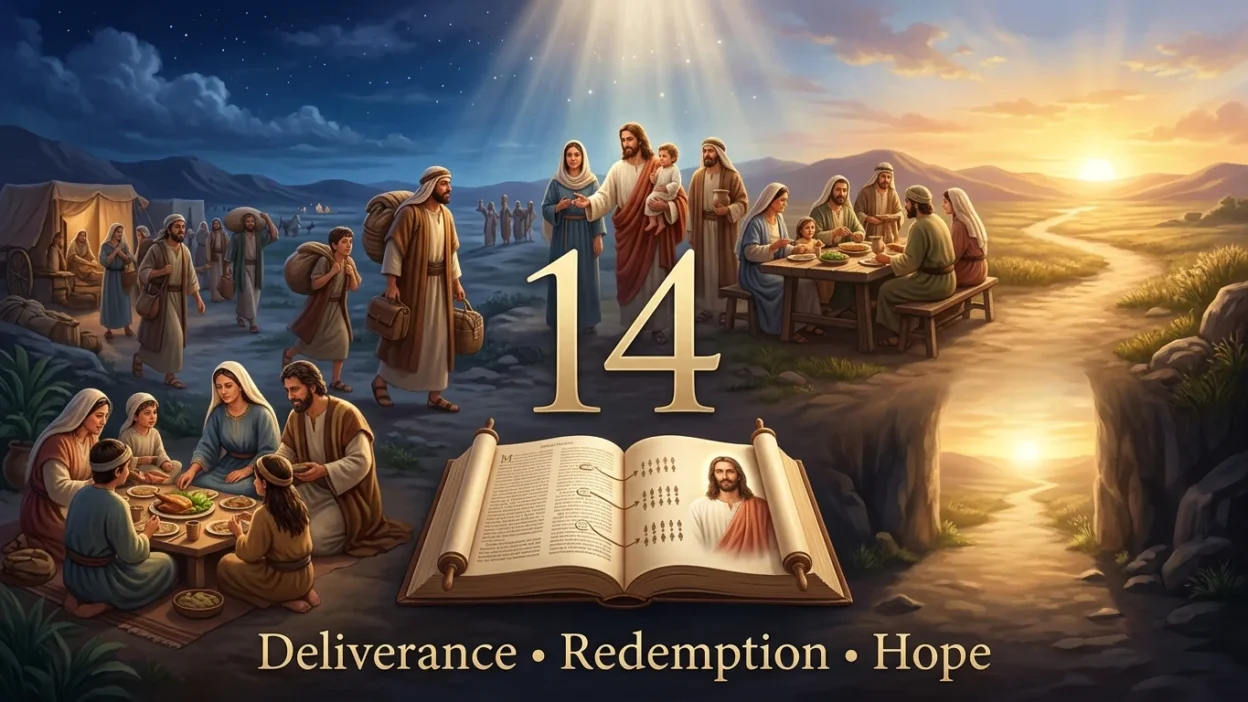
The biblical meaning of number 14 is often connected with deliverance, salvation, and God’s appointed timing. The number appears in several important biblical passages, most notably in the genealogy of Jesus in Matthew 1, where Matthew deliberately organizes Christ’s genealogy into three groups of fourteen generations. Because of this pattern, many Bible readers associate 14 with God’s redemptive plan and the arrival of the Messiah.
The number 14 in the Bible also has an important connection with the Passover. God commanded Israel to observe Passover on the fourteenth day of the first month (Exodus 12:6; Leviticus 23:5). Since Passover commemorates Israel’s deliverance from Egypt, the number can carry a strong symbolic association with freedom, rescue, redemption, and God’s faithfulness.
Quick Answer
The biblical meaning of number 14 is commonly associated with deliverance, redemption, salvation, and God’s appointed timing. The fourteenth day is connected with Passover, while Matthew emphasizes three sets of 14 generations leading to Jesus.
What Does Number 14 Mean in the Bible?
The Bible does not explicitly say, “the number 14 means X.” Therefore, we should distinguish between what Scripture directly states and what biblical symbolism suggests.
Several important passages connect the number 14 with significant events.
The strongest associations are:
- Deliverance
- Redemption
- Salvation
- Passover
- God’s timing
- Fulfillment of God’s promises
| Aspect | Biblical Connection |
|---|---|
| Number | 14 |
| Strongest Connection | Passover |
| Key Event | Israel’s deliverance from Egypt |
| Matthew’s Pattern | Three groups of 14 generations |
| Symbolic Themes | Redemption, salvation, deliverance |
Number 14 and the Passover
One of the clearest biblical connections to 14 appears in the Passover instructions.
In Exodus 12:6, God instructed Israel to keep the Passover lamb until the fourteenth day of the month and then sacrifice it at twilight.
Leviticus 23:5 similarly identifies the fourteenth day of the first month as the time for Passover.
Passover commemorated God’s dramatic rescue of Israel from slavery in Egypt.
Because of this, number 14 can be associated with:
Deliverance from bondage → God’s intervention → Redemption → New freedom
This is one of the strongest foundations for interpreting the number spiritually.
Number 14 in Matthew’s Genealogy
Another major appearance occurs in Matthew 1:17.
Matthew organizes the genealogy of Jesus into three groups of fourteen generations:
- Abraham to David — 14 generations
- David to the Babylonian exile — 14 generations
- The exile to Christ — 14 generations
This deliberate structure draws attention to God’s unfolding plan throughout Israel’s history.
It ultimately leads the reader to Jesus Christ, the Messiah.
Therefore, number 14 can be associated with God’s redemptive plan and the fulfillment of His promises.
Why Is 14 Important in Matthew?
Matthew’s use of three groups of 14 appears intentional.
The genealogy moves through major stages:
Abraham → David → Exile → Christ
Each stage represents an important period in God’s relationship with His people.
The final movement toward Christ gives the number a strong association with Messianic fulfillment.
However, Christians should avoid claiming that every occurrence of 14 in Scripture contains a hidden prophetic message. Matthew’s genealogy is the clearest example of intentional numerical structure.
Spiritual Meaning of Number 14
The spiritual meaning commonly associated with 14 centers on God bringing people from bondage into freedom and fulfilling His promises at the right time.
Number 14 can symbolize:
- Deliverance
- Redemption
- Salvation
- Freedom
- Faithfulness
- Fulfillment
- God’s timing
- Hope
- New beginnings
The Passover connection particularly strengthens the theme of deliverance.
Number 14 and Redemption
Redemption is one of the most important spiritual ideas connected with number 14.
During Passover, God delivered Israel from Egyptian slavery. Centuries later, Jesus became central to the Christian understanding of redemption.
Matthew’s genealogy deliberately leads toward Christ.
Therefore, Christians may see a beautiful thematic connection:
Passover → Deliverance → Redemption → Christ
This does not mean Scripture formally declares 14 to be a universal “redemption number,” but these passages provide a reasonable basis for spiritual reflection.
Number 14 and New Beginnings
Deliverance often creates the possibility of a new beginning.
Israel’s departure from Egypt marked the beginning of a new chapter as a people freed from slavery.
Similarly, the genealogy in Matthew leads from Israel’s history toward the arrival of Jesus.
Therefore, some Christians associate 14 with:
- Leaving the past behind
- Entering a new season
- Experiencing spiritual renewal
- Trusting God’s direction
- Moving toward God’s promises
Number 14 and God’s Timing
The Passover occurred on a specific appointed day: the fourteenth day of the first month.
This shows that biblical deliverance happened according to God’s instructions and timing.
The genealogy in Matthew also demonstrates a long historical progression toward Christ.
Together, these passages can remind believers that God’s purposes unfold according to His timing, even when people cannot immediately see the whole plan.
Number 14 and Jesus Christ
The connection between 14 and Jesus is especially significant in Matthew 1.
Matthew ends his carefully structured genealogy with:
“Christ”
The number therefore appears within a genealogy designed to demonstrate Jesus’ place in Israel’s history.
For Christians, this can make 14 a reminder of:
- God’s promises
- The Messiah
- Salvation
- Redemption
- Fulfillment
- God’s faithfulness
Is 14 a Lucky or Unlucky Number in the Bible?
The Bible does not describe 14 as lucky or unlucky.
Biblical numerology differs from superstition.
Instead of treating numbers as magical forces, it is better to examine how biblical authors actually use them.
With 14, the strongest biblical examples point toward Passover and Matthew’s genealogy, rather than luck or fortune.
Number 14 Compared With Other Biblical Numbers
| Number | Common Biblical Association | Key Example |
|---|---|---|
| 3 | Completeness / emphasis | Trinity, resurrection |
| 7 | Completion / fullness | Seven days of creation |
| 12 | God’s people / government | Twelve tribes |
| 14 | Deliverance / redemption themes | Passover, Matthew 1 |
| 40 | Testing / preparation | Israel’s wilderness |
These associations should be understood as themes rather than rigid mathematical definitions.
Is There a Hidden Message Behind Seeing 14?
Some people notice the number 14 repeatedly and wonder whether God is sending them a personal message.
The Bible does not teach that repeatedly seeing a particular number automatically carries a supernatural message.
Instead, if number 14 reminds you of Scripture, you can use it as an opportunity to reflect on biblical themes such as God’s deliverance, redemption, faithfulness, and promises.
The important thing is to keep the focus on God and Scripture rather than the number itself.
What Can Number 14 Teach Christians Today?
The biblical passages associated with 14 can offer several practical lessons.
Trust God’s Deliverance
Passover reminds believers that God can rescue people from circumstances they cannot overcome alone.
Remember God’s Faithfulness
Matthew’s genealogy demonstrates God’s long-term faithfulness across generations.
Wait for God’s Timing
God’s purposes may unfold over long periods, but delay does not necessarily mean abandonment.
Embrace New Beginnings
Deliverance from slavery opened a new chapter for Israel.
Keep Your Focus on Christ
Matthew’s genealogy ultimately points toward Jesus, making Christ more important than the numerical pattern itself.
Final Thought
The biblical meaning of number 14 is most strongly connected with deliverance, redemption, salvation, and God’s faithfulness. Scripture does not provide a single official definition for the number, so we should avoid treating it as a magical or universal code. However, its connection with Passover on the fourteenth day and Matthew’s deliberate use of three groups of fourteen generations gives the number meaningful biblical symbolism.
For Christians, 14 can serve as a reminder that God delivers His people, keeps His promises, and works through history according to His purposes. Most importantly, the biblical significance of the number ultimately points us away from numerology and back toward God’s redemptive work and the hope found in Jesus Christ.
FAQs
What is the biblical meaning of number 14?
Number 14 is commonly associated with deliverance, redemption, salvation, God’s faithfulness, and fulfillment because of its connection with Passover and Matthew’s genealogy.
Why is 14 important in the Bible?
The fourteenth day is associated with Passover, and Matthew 1:17 organizes Jesus’ genealogy into three groups of fourteen generations.
What does 14 symbolize spiritually?
It can symbolize deliverance, freedom, redemption, God’s timing, hope, and fulfillment of His promises.
Is 14 a lucky number in the Bible?
No. The Bible does not describe 14 as lucky or unlucky.
What does 14 have to do with Jesus?
Matthew structures Jesus’ genealogy around three groups of 14 generations, connecting the number with the historical progression toward the Messiah.
Is seeing number 14 repeatedly a biblical sign?
Scripture does not teach that repeatedly seeing a number automatically represents a divine message. It is better to focus on what the Bible actually teaches about the number.

Adrian Vossley is a digital content specialist with extensive experience in SEO writing, content optimization, and online publishing. He develops high-quality articles that balance search performance with reader engagement. His approach emphasizes research, accuracy, and sustainable content strategies. Adrian continually studies evolving search engine guidelines to refine his editorial process.