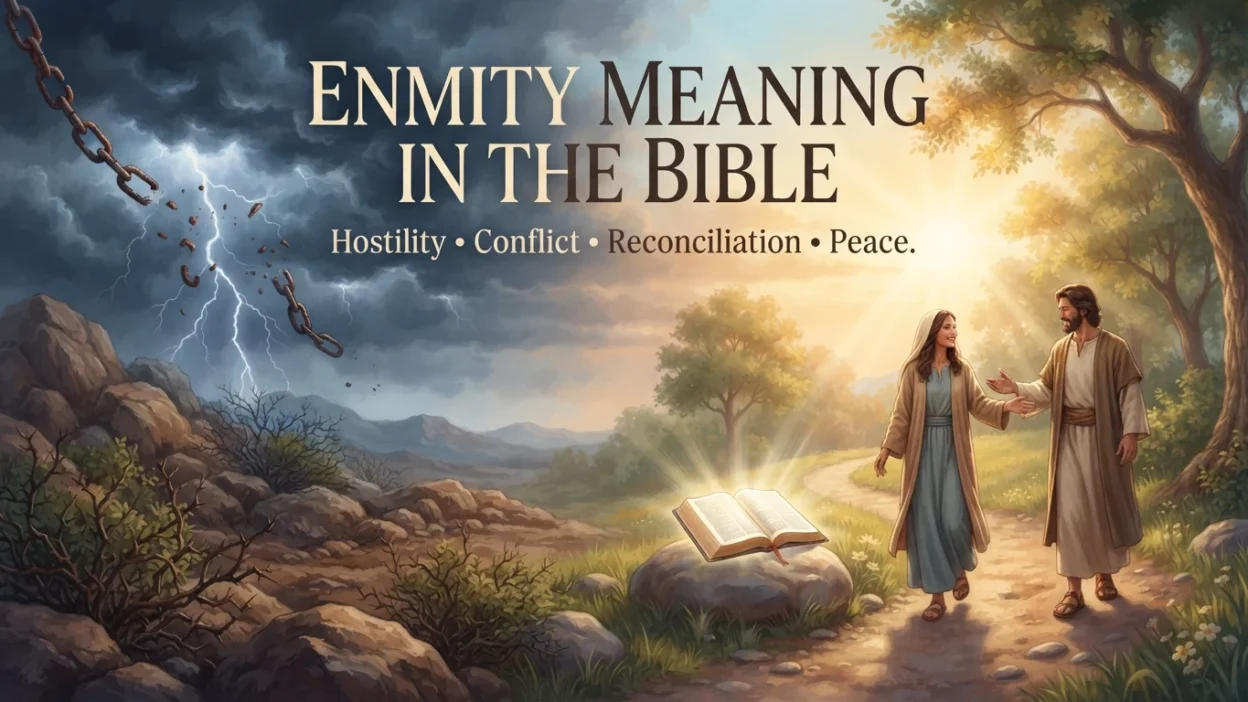
The enmity meaning in the Bible is closely connected with hostility, hatred, opposition, conflict, and separation between individuals or groups. Although “enmity” may sound like an old-fashioned word today, it appears in important biblical passages and describes a serious form of ongoing hostility.
The most famous biblical reference appears in Genesis 3:15, where God speaks about putting “enmity” between the serpent and the woman, and between their offspring. The word also helps explain the conflict between sin and righteousness, humanity and God, and opposing spiritual forces. However, the Bible also teaches reconciliation, forgiveness, love, and peace. Therefore, understanding enmity in Scripture involves recognizing both the reality of hostility and God’s desire to overcome destructive division.
Quick Answer
The enmity meaning in the Bible is deep hostility, hatred, opposition, or ongoing conflict between people, groups, or opposing forces.
In Genesis 3:15, God speaks of enmity between the serpent and the woman, making the word especially important in biblical discussions about sin, spiritual conflict, and God’s plan of redemption.
What Does Enmity Mean?
The word enmity means a state of strong hostility or opposition.
It describes something deeper than a temporary disagreement.
For example, two people can disagree without becoming enemies. However, enmity involves persistent hostility or antagonism.
Common meanings include:
- Hostility
- Hatred
- Opposition
- Conflict
- Enemy-like feelings
- Deep disagreement
- Separation
In biblical language, enmity can describe conflict between people, groups, or opposing spiritual realities.
Enmity in Genesis 3:15
The most significant reference appears in Genesis 3:15.
After the serpent deceives Eve, God speaks about putting enmity between the serpent and the woman and between their offspring.
This verse stands within the story of humanity’s fall into sin and God’s response to that rebellion.
The passage introduces a continuing conflict between the serpent and humanity.
For Christians, Genesis 3:15 also has major theological importance because many Christian interpreters understand it as an early indication of God’s plan for ultimate victory over evil through Christ.
This is why Genesis 3:15 is sometimes called the protoevangelium, meaning “first gospel,” in Christian theological tradition.
Enmity and the Serpent
The serpent in Genesis represents a major source of temptation and opposition to God’s purposes.
God’s declaration of enmity therefore establishes a profound conflict.
The passage does not present the serpent and humanity as natural allies.
Instead, it describes a relationship marked by opposition and conflict.
From a Christian perspective, this conflict ultimately connects with the larger biblical story of sin, temptation, redemption, and victory over evil.
Enmity and Sin
The Bible frequently presents sin as something that places people in opposition to God’s will.
Sin involves rebellion, disobedience, and separation from God.
James 4:4 uses particularly strong language when it describes friendship with the world in opposition to friendship with God.
This helps illustrate a broader biblical principle:
What opposes God’s righteousness creates spiritual conflict.
Therefore, enmity can describe more than interpersonal hatred. It can also describe spiritual opposition.
Enmity Against God
One of the strongest New Testament references appears in Romans 8:7.
Paul explains that the mind governed by the flesh is hostile toward God and does not submit to God’s law.
The underlying concept closely corresponds to enmity or hostility toward God.
This does not mean every person consciously wakes up wanting to hate God.
Rather, Paul describes the condition of a life controlled by sinful human nature as fundamentally opposed to God’s ways.
The passage therefore highlights the seriousness of spiritual rebellion.
Enmity and the Human Heart
Biblical enmity can also involve the inner attitudes of people.
Hatred, resentment, jealousy, pride, revenge, and unforgiveness can create hostility between individuals.
Jesus repeatedly taught His followers to move in the opposite direction.
Instead of cultivating hatred, He taught love for enemies, forgiveness, mercy, and reconciliation.
Therefore, the Bible does not simply identify enmity. It also provides a path toward overcoming it.
Enmity vs. Hatred
Although the two ideas overlap, they are not always identical.
Hatred can describe a strong negative feeling toward someone.
Enmity emphasizes a state or relationship of hostility and opposition.
| Hatred | Enmity |
|---|---|
| Strong dislike or hostility | Ongoing state of opposition |
| Can be emotional | Often describes a hostile relationship |
| May be temporary | Often suggests persistent conflict |
| Can exist internally | Commonly describes conflict between parties |
| Focuses on attitude | Focuses on hostility or opposition |
Therefore, enmity can involve hatred, but it often communicates something broader: a continuing relationship of hostility.
Enmity and Reconciliation
One of the most encouraging biblical themes is that God does not leave humanity trapped in hostility.
The New Testament repeatedly emphasizes reconciliation.
Through Christ, people can be reconciled to God and to one another.
Paul explains in Ephesians 2 that Christ brings peace and breaks down barriers of hostility between people.
This provides an important contrast:
Enmity creates separation.
Christ brings reconciliation.
This movement from hostility toward peace represents one of the central themes of the Christian message.
Enmity and Jesus Christ
The New Testament presents Jesus as the One through whom God brings reconciliation.
Humanity’s sin creates separation from God, but Christ’s work addresses that separation.
Colossians 1:20–22 describes reconciliation through Christ.
Consequently, the biblical story does not end with enmity.
It moves toward peace, restoration, forgiveness, and reconciliation.
This makes the concept especially important for understanding the broader biblical story.
Spiritual Meaning of Enmity
From a Christian perspective, enmity can represent:
- Opposition to God
- The destructive power of hatred
- Conflict caused by sin
- Spiritual warfare
- Separation
- Broken relationships
- The need for reconciliation
- Victory over evil
However, Scripture does not encourage believers to create hostility simply because the Bible discusses enmity.
Instead, Christians are repeatedly encouraged to pursue peace and righteousness.
Enmity Between the Flesh and the Spirit
Galatians 5 describes a conflict between the flesh and the Spirit.
Paul explains that these opposing desires work against each other.
Although Galatians 5 does not use the word “enmity” in the same way as Genesis 3:15, the passage illustrates a similar concept of opposing directions.
One direction follows sinful desires.
The other follows the work of God’s Spirit.
This gives Christians an important spiritual lesson: following God involves learning to reject destructive desires and allow the Spirit to shape one’s life.
Enmity and Spiritual Warfare
The Bible also describes a broader conflict between good and evil.
Ephesians 6:12 reminds believers that their struggle is not merely against human beings but involves spiritual forces of evil.
This does not mean Christians should treat ordinary disagreements as spiritual warfare.
Instead, the passage encourages believers to recognize the spiritual dimension of their faith while responding with truth, righteousness, faith, prayer, and perseverance.
Therefore, biblical enmity should not become an excuse for hatred toward other people.
Does Enmity Always Mean Hatred?
Not necessarily.
Enmity describes hostility or opposition, but the intensity and form can vary according to context.
For example, Genesis 3:15 describes a profound conflict involving the serpent and the woman’s offspring.
Romans 8:7 describes hostility toward God.
Other contexts may describe conflict between people or groups.
Therefore, always examine the specific passage rather than assuming every use carries exactly the same meaning.
What Does Enmity Mean Spiritually?
Spiritually, enmity can help us recognize the difference between God’s ways and destructive opposition to Him.
It can remind believers that:
Sin creates separation.
Hatred damages relationships.
Pride can create conflict.
Unforgiveness can deepen hostility.
God calls people toward reconciliation.
This makes enmity more than a vocabulary word. It becomes a useful concept for understanding human relationships and spiritual conflict.
What Does It Mean to Overcome Enmity?
According to the Bible, overcoming hostility involves qualities such as:
Forgiveness
Jesus teaches His followers to forgive rather than seek revenge.
Love
Jesus commands His followers to love even their enemies.
Humility
Pride often intensifies conflict, while humility can help restore relationships.
Peace
Romans 12:18 encourages believers, as far as it depends on them, to live peacefully with others.
Reconciliation
The biblical goal is not simply to avoid fighting. It is to pursue restored relationships where possible.
Enmity and Modern Relationships
The concept remains highly relevant today.
Enmity can develop through:
- Family conflict
- Broken friendships
- Workplace disputes
- Jealousy
- Resentment
- Betrayal
- Unresolved anger
- Group divisions
The biblical response does not mean ignoring wrongdoing or remaining in unsafe situations.
Instead, Scripture encourages people to avoid revenge and hatred while seeking wisdom, justice, forgiveness, and peace.
Common Misconceptions About Enmity
Myth 1: Enmity means you must hate your enemies.
No. Scripture describes hostility but repeatedly teaches believers to love their enemies and pursue peace.
Myth 2: Everyone who disagrees with you is your spiritual enemy.
The Bible does not support treating every disagreement as spiritual warfare.
Myth 3: Enmity always refers to Satan.
Not always. Biblical contexts can involve people, groups, sinful attitudes, or spiritual opposition.
Myth 4: Enmity cannot be overcome.
The New Testament strongly emphasizes reconciliation and peace through Christ.
Myth 5: Enmity means Christians should avoid everyone who opposes them.
Christian teaching emphasizes love, wisdom, forgiveness, and peace. Boundaries can still be appropriate when necessary, but hatred is not the goal.
Biblical Lessons From Enmity
The concept of enmity teaches several important lessons.
First, sin can create separation.
Disobedience to God damages our relationship with Him and with others.
Second, hatred can become destructive.
Unresolved hostility can damage individuals and communities.
Third, spiritual conflict is real in the biblical worldview.
Scripture describes opposition between God’s purposes and evil.
Fourth, reconciliation is possible.
The gospel emphasizes peace and restored relationships through Christ.
Finally, Christians are called to respond differently.
Instead of returning hatred with hatred, believers are encouraged to practice love, forgiveness, mercy, and peace.
Frequently Asked Questions
What does enmity mean in the Bible?
Enmity means hostility, opposition, hatred, or ongoing conflict. In Scripture, it can describe conflict between people, spiritual opposition, or hostility toward God.
Where is enmity first mentioned in the Bible?
The word appears prominently in Genesis 3:15, where God declares that He will put enmity between the serpent and the woman and between their offspring.
What does enmity mean in Genesis 3:15?
In Genesis 3:15, enmity refers to hostility and ongoing opposition between the serpent and the woman and their respective offspring. Christians often connect this passage with the larger biblical story of redemption and Christ’s victory over evil.
What does enmity against God mean?
Enmity against God refers to hostility or opposition toward God and His ways. Romans 8:7 describes the mind governed by the flesh as hostile toward God.
Is enmity the same as hatred?
They are closely related, but enmity emphasizes a state of hostility or opposition, while hatred can describe a strong negative feeling toward someone.
How does the Bible say to overcome enmity?
The Bible encourages love, forgiveness, humility, peace, prayer, and reconciliation rather than revenge or hatred.
Can enmity be spiritual?
Yes. Scripture describes spiritual opposition between God’s purposes and evil. However, believers should not automatically label every personal disagreement as spiritual warfare.
What is the opposite of enmity in the Bible?
The opposite of enmity is peace, friendship, love, reconciliation, and unity. The New Testament especially emphasizes reconciliation through Jesus Christ.
Final Thought
The enmity meaning in the Bible describes something deeper than an ordinary disagreement. It points to hostility, opposition, conflict, and separation, especially in passages such as Genesis 3:15 and Romans 8:7. Yet Scripture does not present enmity as the final answer to conflict.
Instead, the biblical story moves from sin and separation toward forgiveness and reconciliation. Through Christ, the Bible presents a path toward peace with God and, where possible, peace with other people. When we understand enmity, we can also appreciate why Scripture places such strong emphasis on love, forgiveness, humility, and reconciliation.
The presence of conflict in Scripture reminds us of the seriousness of sin, while God’s call to reconciliation reminds us of the power of His grace.

Rowan Ashmere is an experienced content strategist specializing in SEO, digital publishing, and editorial planning. He creates informative content designed to improve online visibility while maintaining a strong focus on quality and user experience. His work combines thorough research, strategic optimization, and clear communication. Rowan enjoys analyzing search trends and developing content that delivers long-term value.